Built-In Microwave vs Countertop: Which Is Better for an Indian Modular Kitchen?
Ammon Marketing
Authorized Kutchina Dealer · Ranchi
02 Jul 2026
~ read
TL;DR
- Built-in microwave saves counter space and looks seamless — but costs 25–40% more than a countertop model and is harder to replace
- Countertop microwave is more flexible, cheaper, and easier to service — the right choice for most Indian families
- Convection microwave (not solo) is essential for Indian kitchens — needed for baking, grilling, and heating
- OTG (oven toaster griller) does baking and grilling better than a microwave but cannot reheat — many Indian kitchens need both
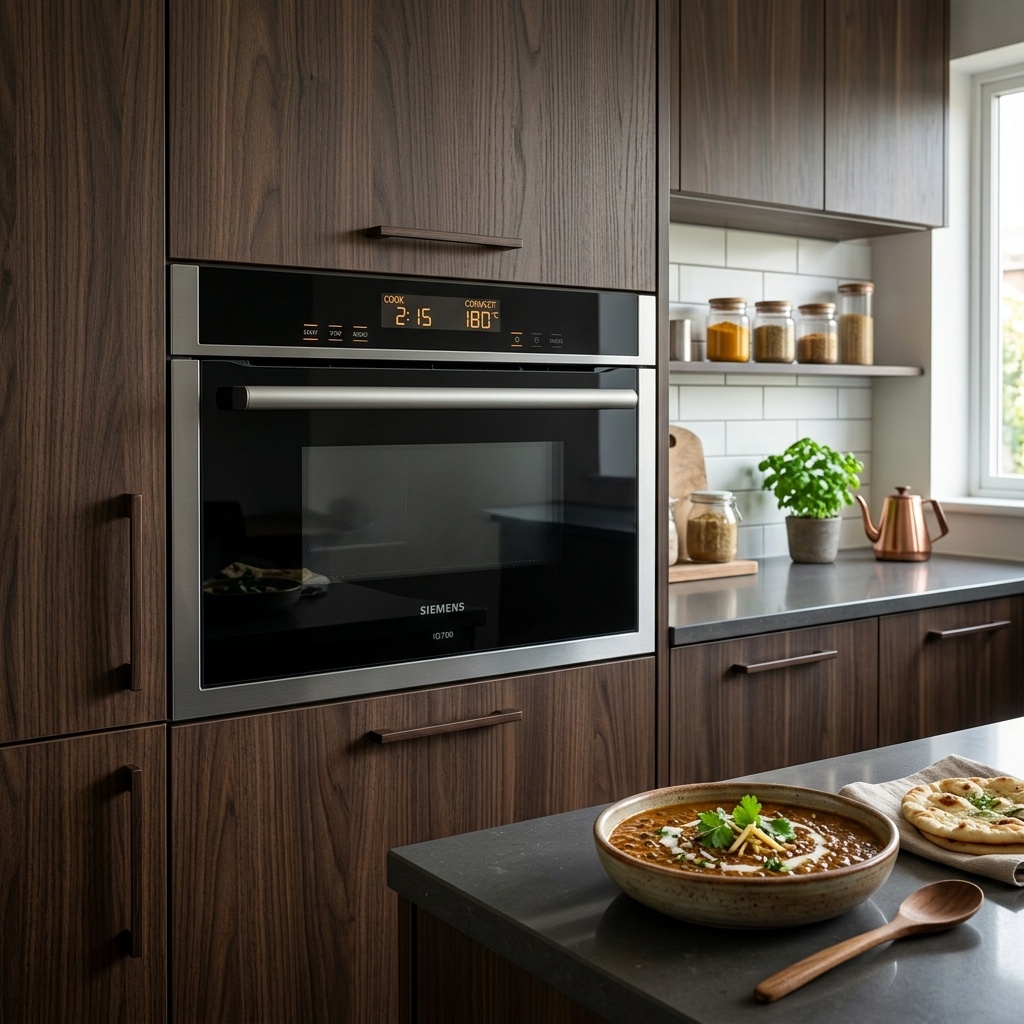
Quick Answer: For a modular kitchen, a built-in microwave makes sense if you: (1) have a dedicated tall unit or wall cabinet slot planned, (2) are buying a premium kitchen where the seamless look matters, and (3) will stay in this home for 5+ years. For most Indian families, a countertop convection microwave (28–32L capacity) placed on the counter or in an open shelf gives the same functionality at lower cost with easier serviceability.
Built-In vs Countertop Microwave
| Factor | Built-In Microwave | Countertop Microwave |
|---|---|---|
| Counter space | Zero counter space used | Uses 1.5–2 sq ft of counter |
| Appearance | Seamless — flush with cabinet face | Appliance visible on counter |
| Cost | ₹18,000–₹50,000+ | ₹8,000–₹25,000 |
| Installation | Requires dedicated cabinet slot with ventilation | Plug and use — no installation |
| Replaceability | Harder — must match cavity size | Plug in replacement in minutes |
| Serviceability | Cabinet must be opened for service access | Easy — directly accessible |
| Ventilation requirement | Trim kit and ventilation must be planned | Built-in top/back ventilation — no planning needed |
| Flexibility | Fixed location — cannot relocate easily | Can be moved to any counter space |
| Best for | Premium modular kitchen with tall unit planned | Most Indian households — practical and cost-effective |
Microwave Types: Which Does an Indian Kitchen Need?
| Type | Reheating | Baking | Grilling | Cost | Verdict |
|---|---|---|---|---|---|
| Solo microwave | Yes | No | No | ₹5,000–₹12,000 | Too limited for Indian kitchens — only reheats |
| Grill microwave | Yes | No | Yes | ₹8,000–₹16,000 | Good if you primarily grill; no baking |
| Convection microwave | Yes | Yes | Yes | ₹10,000–₹25,000 | Best all-in-one for Indian families — do this |
| OTG (oven toaster griller) | No | Excellent | Excellent | ₹4,000–₹15,000 | Better baking quality but cannot reheat — pair with solo microwave |
Frequently Asked Questions
Should I get a built-in microwave for my modular kitchen?
Only if you are planning a tall unit (a floor-to-ceiling cabinet tower) in your modular kitchen design — this is the standard location for a built-in microwave, positioned at eye level between base cabinets below and wall cabinets above. If your kitchen design doesn't include a tall unit, a built-in microwave requires special cavity treatment. For most Indian 2–3 BHK kitchens, a countertop convection microwave in an open shelf or counter corner is more practical.
What is the difference between solo, grill, and convection microwave?
Solo microwave: only heats/reheats using microwaves — cannot bake or grill. Grill microwave: heats and grills (top grill element) — useful for chicken tikka, sandwiches, but cannot bake. Convection microwave: heats, grills, AND bakes using hot air circulation — the most versatile and recommended for Indian kitchens that want one appliance for all three functions. If you bake frequently and want oven-quality results, an OTG gives better baking performance than a convection microwave.
What size microwave is best for Indian family?
For a family of 4–5: 28–32 litre capacity convection microwave. This accommodates a standard 2kg cake tin, a full chicken, and is large enough for reheating family-size portions. For a couple or small family (2–3 members): 23–25 litre is sufficient. Under 20 litre is too small for Indian cooking vessel sizes — a pressure cooker or large handi won't fit for reheating.
Can a microwave replace an OTG for baking?
A convection microwave can substitute for an OTG for occasional baking — cookies, cakes, small breads. For serious or frequent baking, an OTG gives better results: more even heat distribution (top and bottom heating elements), better temperature stability, and more capacity. If you bake more than once a week, an OTG (₹4,000–₹15,000) is worth having alongside a convection microwave. If you bake occasionally, the convection microwave alone is sufficient.
Where should a microwave go in a modular kitchen?
Three standard locations: (1) In a tall unit at eye level (55–65 cm from floor) — the most ergonomic and visually seamless placement, (2) On the counter in an open shelf under a wall cabinet — accessible without bending, (3) On the main counter — convenient but uses counter space. Avoid: below the counter (bending to use it is impractical and unsafe with hot food), and above 170 cm height (pouring out hot liquids from an overhead microwave is a burn risk).
Is built-in microwave worth the extra cost?
For a premium modular kitchen where the aesthetic matters and you have a tall unit planned: yes, the ₹8,000–₹20,000 premium for a built-in model is worthwhile. For a practical family kitchen where the priority is functionality and budget: no — a quality countertop convection microwave (LG, Samsung, IFB at ₹12,000–₹18,000) gives identical cooking performance, is easier to service, and can be moved or replaced without any cabinet modification.
What brands of microwave are best in India?
In India, LG and Samsung are the most popular microwave brands with the widest service networks. IFB is known for quality build and good after-sales in Tier 2 cities. Panasonic and Whirlpool are reliable alternatives. For built-in kitchen microwaves, Bosch, Siemens, and Miele are premium choices aligned with European kitchen brands. For a Ranchi family, LG or Samsung 28L convection microwave (₹13,000–₹18,000) is the most practical recommendation for daily use.
Should I plan the microwave before installing modular kitchen?
Yes — always decide before installation: (1) If built-in: confirm brand, model, and dimensions — the cabinet cavity is built to those exact measurements, (2) If countertop: tell your designer where you want the microwave placed so a dedicated counter section and electrical socket (15A) are planned there, (3) Electrical socket: a dedicated 15A socket for the microwave (separately fused from the main kitchen circuit) should be planned in the design stage. Adding it after installation costs more and requires wall opening.
Key Takeaways
- Convection microwave (not solo) is essential for Indian kitchens — enables reheating, grilling, and baking in one appliance
- Built-in microwave suits premium kitchens with a planned tall unit; countertop is the practical choice for most families
- Always plan microwave location and electrical socket before kitchen installation — retrofitting costs significantly more
- 28–32L capacity suits a family of 4–5; under 20L is too small for Indian vessel sizes
- LG, Samsung, and IFB have the best service networks for Indian families — prioritise service reach over brand prestige
See These Ideas in Real Homes

Free · No Obligation
Talk to Our Design Experts
Ammon Marketing Editorial Team
Authorized Kutchina Dealer · Ranchi · Est. 2014
Our guides are written by Ranchi-based kitchen designers and appliance experts with 10+ years of on-the-ground experience. Every recommendation is based on real projects completed in Jharkhand homes — not generic advice from outside the region.