Kitchen Chimney Installation Guide: Correct Height, Placement & Suction Capacity
Ammon Marketing
Authorized Kutchina Dealer · Ranchi
02 Jul 2026
~ read
TL;DR
- Standard chimney mounting height: 65–75 cm (26–30 inches) above an electric hob; 75–85 cm above a gas hob
- The chimney must be centred directly above the hob — even 3–4 inches off-centre reduces effectiveness significantly
- Suction capacity rule: 10× the kitchen volume in m³/hr for a closed kitchen; 15× for an open kitchen
- A recirculating chimney (no external duct) works but is less effective — ducted chimney is always better for Indian cooking
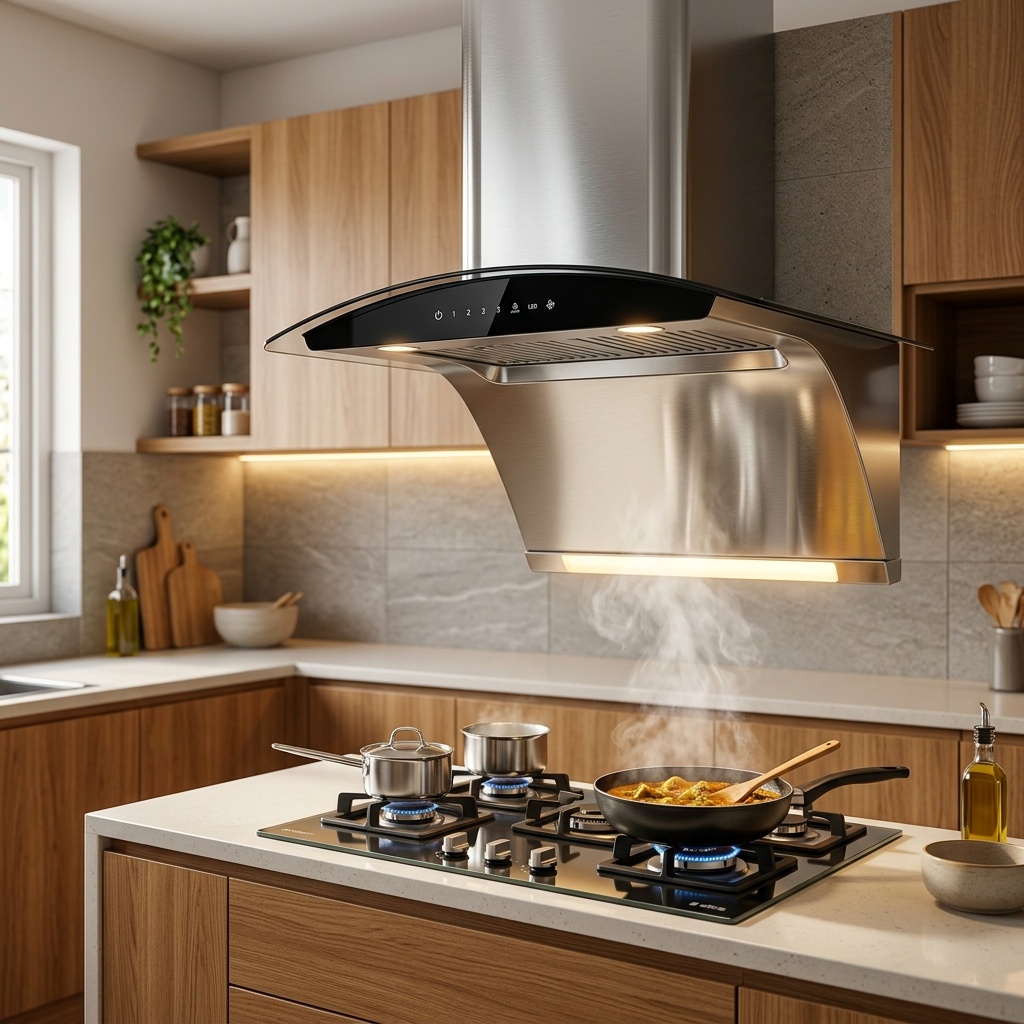
Quick Answer:Mount your kitchen chimney 65–75 cm above an electric hob or 75–85 cm above a gas hob, centred directly over the burners. For suction, calculate your kitchen volume (length × width × height in metres) and multiply by 10 for a closed kitchen or 15 for an open kitchen — that's the minimum m³/hr you need. A ducted (external vent) chimney always outperforms a recirculating model for Indian cooking.
A wrongly mounted chimney is one of the most common and expensive modular kitchen mistakes. Mounted too low, it gets in the way during cooking. Mounted too high or off-centre, it fails to capture smoke efficiently. This guide gives you the exact specifications so your chimney works as designed — not just looks installed.
Correct Chimney Mounting Height
| Hob Type | Minimum Height | Recommended Height | Maximum Height |
|---|---|---|---|
| Gas hob (open flame) | 75 cm | 75–85 cm | 90 cm |
| Electric / induction hob | 65 cm | 65–75 cm | 80 cm |
| Island hob (overhead chimney) | 75 cm | 80–90 cm | 100 cm |
Height is measured from the top of the hob surface to the bottom of the chimney body. The duct above does not count in this measurement.
Why the height range exists: Mount too low (under 65 cm) and the chimney body interferes with tall vessels and wok cooking. Mount too high (above 90 cm for gas) and smoke spreads horizontally before it reaches the suction zone — the chimney captures only a fraction of the cooking vapour. The recommended range is where suction efficiency and clearance are optimally balanced.
Chimney Width: Must Match or Exceed Hob Width
The chimney width (the suction panel) should be equal to or wider than the hob. If the hob is wider than the chimney, the outer burners are partially uncovered and smoke escapes from the sides.
| Hob Size | Minimum Chimney Width | Recommended Chimney Width |
|---|---|---|
| 2-burner hob (60 cm / 600mm) | 60 cm | 60 cm |
| 3-burner hob (60 cm wide) | 60 cm | 60 cm |
| 4-burner hob (75 cm / 750mm) | 75 cm | 90 cm |
| 5-burner hob (90 cm / 900mm) | 90 cm | 90 cm |
Calculating the Right Suction Capacity
Suction capacity is measured in m³/hr (cubic metres per hour). More is not always better — an oversized chimney uses more electricity and makes more noise than needed. The right size is based on your kitchen volume.
Formula:
Kitchen Volume = Length (m) × Width (m) × Height (m)
Minimum Suction = Volume × 10 (closed kitchen) or Volume × 15 (open kitchen)
Example: 3m × 3m × 2.7m kitchen = 24.3 m³. Minimum suction for closed kitchen = 24.3 × 10 = 243 m³/hr. A 1,200 m³/hr chimney is more than sufficient — the standard for most Indian closed kitchens.
| Kitchen Type | Typical Volume | Recommended Suction |
|---|---|---|
| Small closed kitchen (under 80 sq ft) | 20–30 m³ | 600–900 m³/hr |
| Standard closed kitchen (80–120 sq ft) | 30–50 m³ | 1,000–1,200 m³/hr |
| Large closed kitchen (120+ sq ft) | 50–70 m³ | 1,200–1,500 m³/hr |
| Open kitchen (any size) | Add 50% to closed requirement | 1,500+ m³/hr |
Ducted vs Recirculating Chimney
| Factor | Ducted (External Vent) | Recirculating (Filterless / Carbon) |
|---|---|---|
| How it works | Pulls smoke out through duct to exterior | Filters and recirculates air back into kitchen |
| Smoke removal | Complete — smoke exits the home | Partial — smell reduced but not eliminated |
| Grease removal | Excellent — grease exits with smoke | Good — grease caught in filter |
| Best for Indian cooking | Yes — handles heavy frying and spices | Adequate for light cooking; struggle with heavy frying |
| Installation | Requires external duct (wall/ceiling) | No duct needed — easier to install |
| Maintenance | No filter change; chimney body cleaning | Carbon filter replacement every 3–6 months |
| Effectiveness | 100% | 60–70% of ducted equivalent |
Recommendation: Always choose a ducted chimney if you can run a duct to an exterior wall or window — it's significantly more effective for Indian cooking. If ducting is impossible (interior apartment kitchen with no exterior wall access), choose an auto-clean filterless recirculating chimney. Auto-clean technology uses a heated oil collector that drains grease automatically, eliminating mesh filter cleaning.
Frequently Asked Questions
What is the correct height to install a kitchen chimney in India?
Mount the chimney 65–75 cm above an electric or induction hob, and 75–85 cm above a gas hob. Height is measured from the hob surface top to the bottom of the chimney body. Within this range, a taller person may prefer the higher end for clearance, but never exceed 90 cm for gas — beyond that, smoke spreads too wide before the chimney can capture it.
Which side of the kitchen should the chimney be on?
The chimney goes directly above the hob — not on a specific side. The hob position determines the chimney position, not the other way around. The chimney must be centred over the burners. If possible, position the hob against a wall where the duct can exit to the exterior (external wall or above a window). The chimney cannot be moved to a different wall from the hob and remain effective.
What suction power chimney do I need for Indian cooking?
For a standard closed Indian kitchen (80–120 sq ft), a chimney with 1,200 m³/hr suction is sufficient. For heavy daily Indian cooking (daily frying, masala curries), go to 1,300–1,500 m³/hr. For open kitchens, minimum 1,500 m³/hr. Kutchina chimneys from Ammon Marketing range from 1,200–1,500 m³/hr, designed specifically for Indian cooking intensities.
Is auto-clean chimney better than filterless chimney?
Auto-clean and filterless refer to the same technology in most Indian brands — a filterless oil collector with a motorised or heated auto-cleaning mechanism. Standard filterless chimneys collect oil in a drawer that needs manual draining every 2–4 weeks. Auto-clean chimneys heat the oil collector periodically to drain grease automatically into a collection cup — significantly reducing manual maintenance. For Indian cooking, auto-clean is worth the additional cost.
Can chimney be installed without a duct in the wall?
Yes — recirculating chimneys work without an external duct. They filter the air through activated carbon filters and recirculate it back into the kitchen. The limitation: they remove 60–70% of smoke and smell compared to a ducted chimney and require carbon filter replacement every 3–6 months (cost: ₹500–₹1,500 per set). For heavy Indian cooking, ducted is always preferable. If no duct is possible, choose a high-suction auto-clean recirculating model.
How far should chimney be from the wall?
A wall-mount chimney should be mounted flush to the wall or with minimal clearance — the chimney body sits against the wall with the duct running up the wall to the ceiling or exit point. There's no specific minimum distance from the wall. What matters is that the chimney is centred left-to-right over the hob burners, and at the correct height above the hob surface.
What is the difference between a 60 cm and 90 cm chimney?
60 cm (600mm) chimneys suit most 2 and 3-burner hobs (which are typically 60 cm wide). 90 cm (900mm) chimneys suit wider 4 and 5-burner hobs (75–90 cm wide) and provide better coverage for corner and side burners. For most Indian kitchens with a standard 3-burner 60 cm gas hob, a 60 cm chimney is the correct match. Choose 90 cm only if your hob is 75 cm or wider.
How often does a kitchen chimney need servicing?
For Kutchina auto-clean chimneys: the auto-clean cycle should be run every 3–4 weeks (takes about 10 minutes, runs at low heat). The oil collection cup should be emptied every 2–3 months. A professional deep-clean service (oil wash of the motor and interior) is recommended every 12 months — Ammon Marketing offers AMC service for Kutchina chimneys in Ranchi that covers this annual service and any mechanical issues.
Key Takeaways
- Correct height: 65–75 cm for electric hob, 75–85 cm for gas hob — measured from hob surface to chimney bottom
- Always centre the chimney directly above the hob — off-centre placement reduces effectiveness dramatically
- For most standard closed Indian kitchens (80–120 sq ft), 1,200 m³/hr suction is sufficient; open kitchens need 1,500+ m³/hr
- Ducted (external vent) chimney is always more effective than recirculating — choose ducted whenever an exterior duct route is available
- Auto-clean technology is worth the premium for Indian cooking — it eliminates the monthly manual filter-cleaning that standard chimneys require
See These Ideas in Real Homes

Free · No Obligation
Talk to Our Design Experts
Ammon Marketing Editorial Team
Authorized Kutchina Dealer · Ranchi · Est. 2014
Our guides are written by Ranchi-based kitchen designers and appliance experts with 10+ years of on-the-ground experience. Every recommendation is based on real projects completed in Jharkhand homes — not generic advice from outside the region.