Dishwasher Buying Guide India: Do You Actually Need One for Indian Cooking?
Ammon Marketing
Authorized Kutchina Dealer · Ranchi
02 Jul 2026
~ read
TL;DR
- A dishwasher makes sense for Indian homes with 3+ members cooking daily — but only if your kitchen vessels are dishwasher-safe
- Heavy Indian vessels (cast iron, handis, large pressure cookers) are NOT dishwasher-safe — you will still hand-wash these regardless
- A 12–15 place-setting capacity dishwasher uses far less water than hand-washing the same load
- Budget ₹25,000–₹45,000 for a reliable 12-place-setting freestanding dishwasher; built-in models cost ₹35,000–₹70,000+
Quick Answer: A dishwasher is genuinely useful for Indian households where daily cooking generates 20–30 pieces of crockery per meal. It saves time and uses less water than hand-washing. The limitation: heavy Indian vessels (cast iron, large pressure cookers, handis) are not dishwasher-safe and still need hand-washing. If 60%+ of your daily washing is plates, bowls, glasses, and everyday pans — a dishwasher will earn its place.
Dishwasher Types for Indian Homes
| Type | Capacity | Cost | Installation | Best For |
|---|---|---|---|---|
| Freestanding | 12–15 place settings | ₹25,000–₹55,000 | Plug in + plumbing connection — moveable | Most Indian homes — flexible placement near sink |
| Semi-integrated (built-in) | 12–15 place settings | ₹35,000–₹65,000 | Fixed under-counter, control panel visible | Modular kitchen with dedicated under-counter space |
| Fully integrated (built-in) | 12–15 place settings | ₹45,000–₹80,000+ | Fixed under-counter, door panel matches cabinets | Premium modular kitchens wanting seamless look |
| Countertop mini | 6 place settings | ₹8,000–₹18,000 | Countertop — connects to tap temporarily | Bachelors, couples, very small families with limited vessel count |
What IS and IS NOT Dishwasher-Safe in Indian Kitchens
| Item | Dishwasher Safe? | Why |
|---|---|---|
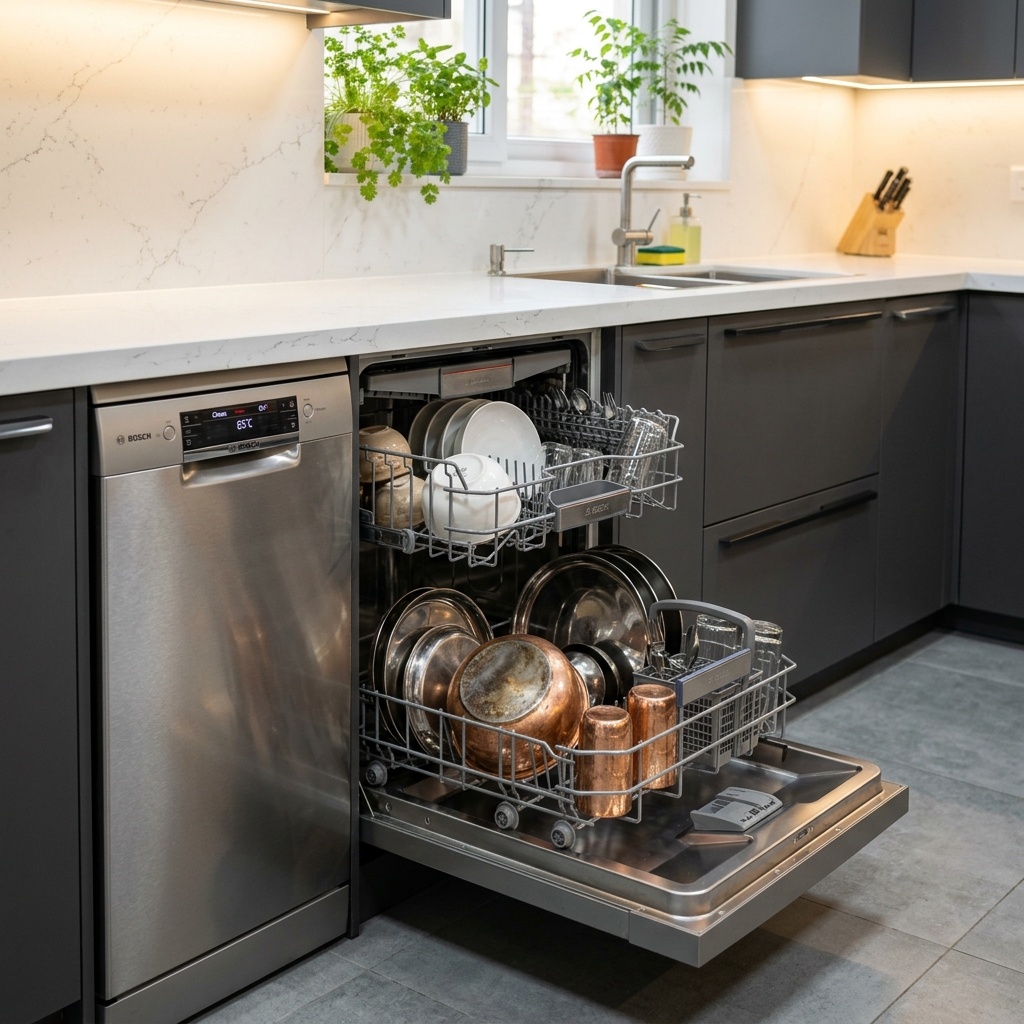
| Stainless steel plates, bowls, glasses | Yes | Safe — most common in Indian households |
| Ceramic and porcelain crockery | Yes (check manufacturer) | Usually safe; avoid antique or hand-painted |
| Regular stainless steel pans and kadais | Yes | Most SS cookware handles dishwasher heat |
| Non-stick pans and tawas | No | Dishwasher detergent damages non-stick coating |
| Cast iron pans and griddles | No | Water ruins seasoning; rust forms instantly |
| Copper and brass vessels | No | Tarnishes and corrodes in dishwasher |
| Large pressure cookers (5L+) | Partially | Body fits; gasket and valve must be hand-washed |
| Handis and earthenware | No | Porous; absorbs water and detergent |
| Wooden cutting boards and spoons | No | Warps and cracks |
| Plastic containers (BPA-free) | Top rack only | Bottom rack heat deforms most plastics |
Dishwasher vs Hand-Washing: Water & Time
| Factor | Dishwasher | Hand-Washing |
|---|---|---|
| Water per full load | 10–14 litres | 40–80 litres (running tap) / 20–30L (bucket method) |
| Time (active) | 5–10 min loading + unloading | 25–45 min for same vessel count |
| Electricity | 1–1.5 kWh per cycle | None (for hand-washing) / hot water heater if used |
| Detergent cost | ₹8–₹15 per tablet (dishwasher pods) | ₹1–₹3 per wash (liquid soap) |
| Hygiene (heat sanitisation) | Yes — 60–70°C wash kills most bacteria | Depends on water temperature and thoroughness |
| Suitable for greasy Indian cooking residue | Good — enzyme detergents handle masala well | Good — with scrubbing |
Frequently Asked Questions
Is a dishwasher worth buying in India?
Yes, for the right household. If your family generates 20–30 pieces of crockery per day (3+ members, daily cooking), and most of your vessels are SS, ceramic, or glass — a dishwasher saves 25–40 minutes of daily washing and uses 3–5x less water than a running tap. The payback in water savings alone is meaningful in Indian cities. The caveat: heavy Indian vessels (cast iron, handis, non-stick) still need hand-washing, so a dishwasher supplements rather than replaces hand-washing entirely.
Can a dishwasher clean Indian cooking residue?
Yes — modern dishwashers with enzyme-based detergent tablets handle masala, curry, and oil residue effectively. The key is pre-scraping (not pre-rinsing) large food particles before loading, and using a quality detergent (Finish or Somat tablets recommended for Indian cooking). Heavily burnt residue or turmeric staining on some vessels may still need a brief pre-soak before the dishwasher cycle.
What size dishwasher should I buy in India?
12-place-setting capacity is the standard and most popular size in India — sufficient for a family of 4–5 including all crockery, glasses, and everyday pans from 2–3 meals. Countertop 6-place-setting models suit couples or bachelors but are too small for family use. 15-place-setting models are available for larger families. For a standard modular kitchen, a 12-place-setting built-in dishwasher occupies a 60cm-wide base cabinet space.
Which dishwasher brand is best in India?
In India, Bosch is the most popular dishwasher brand with the best service network — the SMS series (₹35,000–₹55,000) is the most recommended for Indian conditions. IFB is the value alternative with good after-sales service (₹25,000–₹35,000). Siemens and Whirlpool are also available. For built-in models in modular kitchens, Bosch 12-place-setting semi-integrated models are the most common specification.
Does a dishwasher need a dedicated water connection?
Yes — a dishwasher requires: (1) a cold water supply connection (the same as your kitchen sink cold water line — a plumber adds a T-joint), (2) a drain connection (into the sink drain or directly into the wall drain pipe), (3) a 15A earthed electrical socket nearby. All three should be planned before your modular kitchen installation — adding plumbing and electrical connections after cabinets are installed is expensive and disruptive.
Can I add a dishwasher to an existing modular kitchen?
Yes, if you have: a free 60cm-wide base cabinet space that can be removed, access to the kitchen drain and water supply pipe, and a 15A earthed socket within reach. A plumber and electrician will need to add a water supply tap and drain connection. The dishwasher slides in and connects in a few hours. If your existing modular kitchen has no free space, a countertop mini dishwasher (connects to the tap temporarily) is an alternative.
How much does it cost to run a dishwasher per month in India?
Running cost estimate for a family of 4 running 1 cycle daily: electricity 1.2 kWh × 30 = 36 kWh/month ≈ ₹250–₹350; detergent tablets ₹10/tablet × 30 = ₹300; rinse aid ≈ ₹50/month. Total running cost: approximately ₹600–₹700 per month. Water savings vs running tap washing can partially offset this — a dishwasher uses 10–14L vs 40–80L per tap-running hand-wash load.
Should I plan for a dishwasher before my modular kitchen installation?
Yes — always plan for it even if you are not buying one immediately. Ask your modular kitchen designer to: (1) leave a 60cm-wide base cabinet slot near the sink (or install a removable base unit there), (2) ask your plumber to add a dishwasher water supply tap and drain stub, (3) confirm a 15A socket is available in the base cabinet zone. Retrofitting these connections after cabinets are installed costs ₹5,000–₹15,000 more than planning them upfront.
Key Takeaways
- A dishwasher is worthwhile for families of 3+ with daily cooking — saves time and uses significantly less water than running-tap hand-washing
- Non-stick, cast iron, copper, and earthenware still need hand-washing — a dishwasher supplements, not replaces, hand-washing in Indian kitchens
- Plan plumbing and electrical connections before modular kitchen installation — retrofitting costs significantly more
- 12-place-setting capacity is the standard for Indian families of 4–5 — countertop mini models are too small for daily family use
- Bosch and IFB have the best service networks in India — stick to these for reliable after-sales support
See These Ideas in Real Homes

Free · No Obligation
Talk to Our Design Experts
Ammon Marketing Editorial Team
Authorized Kutchina Dealer · Ranchi · Est. 2014
Our guides are written by Ranchi-based kitchen designers and appliance experts with 10+ years of on-the-ground experience. Every recommendation is based on real projects completed in Jharkhand homes — not generic advice from outside the region.