Kitchen Lighting Guide for Indian Homes: Task, Ambient & Under-Cabinet Lighting
Ammon Marketing
Authorized Kutchina Dealer · Ranchi
02 Jul 2026
~ read
TL;DR
- Under-cabinet LED strips are the single most impactful kitchen lighting upgrade — they eliminate the shadow cast by wall cabinets onto the work counter
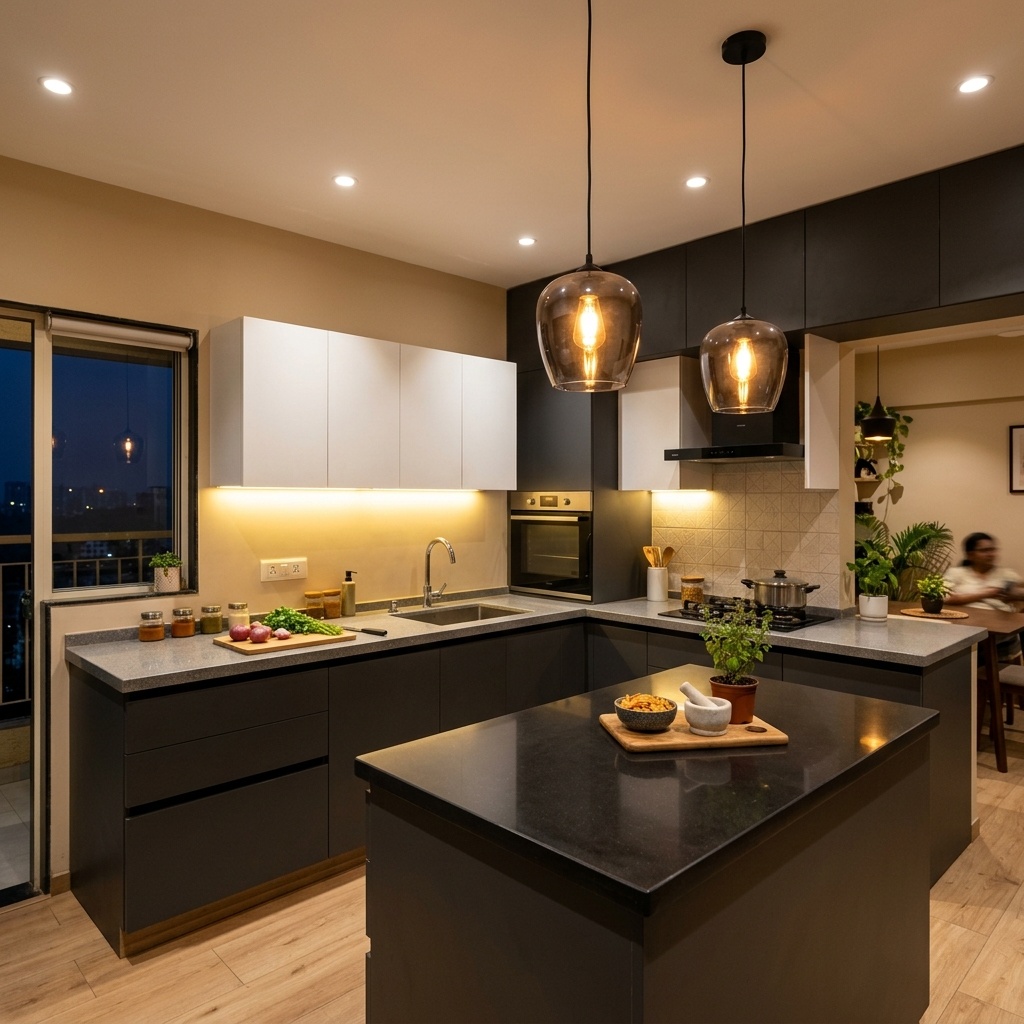
- A kitchen needs three lighting layers: ambient (overall room light), task (counter and cooking zone), and accent (optional — above cabinets or inside glass-door cabinets)
- Warm white (2700–3000K) makes kitchens feel cosy; cool white (4000–5000K) is better for precise food prep and professional-kitchen aesthetics
- Plan electrical points for under-cabinet and chimney lighting during civil work — adding them after kitchen installation is expensive and disruptive
Quick Answer: Every kitchen needs at minimum: one central ceiling light (ambient), under-cabinet LED strips above the counter (task), and a chimney light above the hob (built into the chimney). For a well-lit kitchen, add a recessed spot or panel above each main work zone. Under-cabinet LEDs cost ₹300–₹800 per metre and are the cheapest, highest-impact upgrade in a kitchen.
Poor kitchen lighting causes eye strain during cooking, makes it harder to judge food doneness, and makes even a beautiful kitchen look dingy. Most Indian kitchens are under-lit — a single overhead tube light leaves the counter in shadow (blocked by the wall cabinets above). This guide shows you how to fix that systematically.
The Three Layers of Kitchen Lighting
| Layer | Purpose | Fixture Type | Target Lux | Priority |
|---|---|---|---|---|
| Ambient (General) | Overall room illumination — base light level | Ceiling panel, surface mount, or recessed downlights | 150–300 lux | Essential |
| Task (Work Zone) | Bright focused light on counter, sink, hob | Under-cabinet LED strips, recessed spots above counter | 300–500 lux at surface | Essential |
| Accent (Decorative) | Visual interest — above-cabinet glow, inside cabinets | LED strip above cabinets, puck lights inside glass-door units | No specific target | Optional |
Under-Cabinet LED Strips: The Most Important Kitchen Light
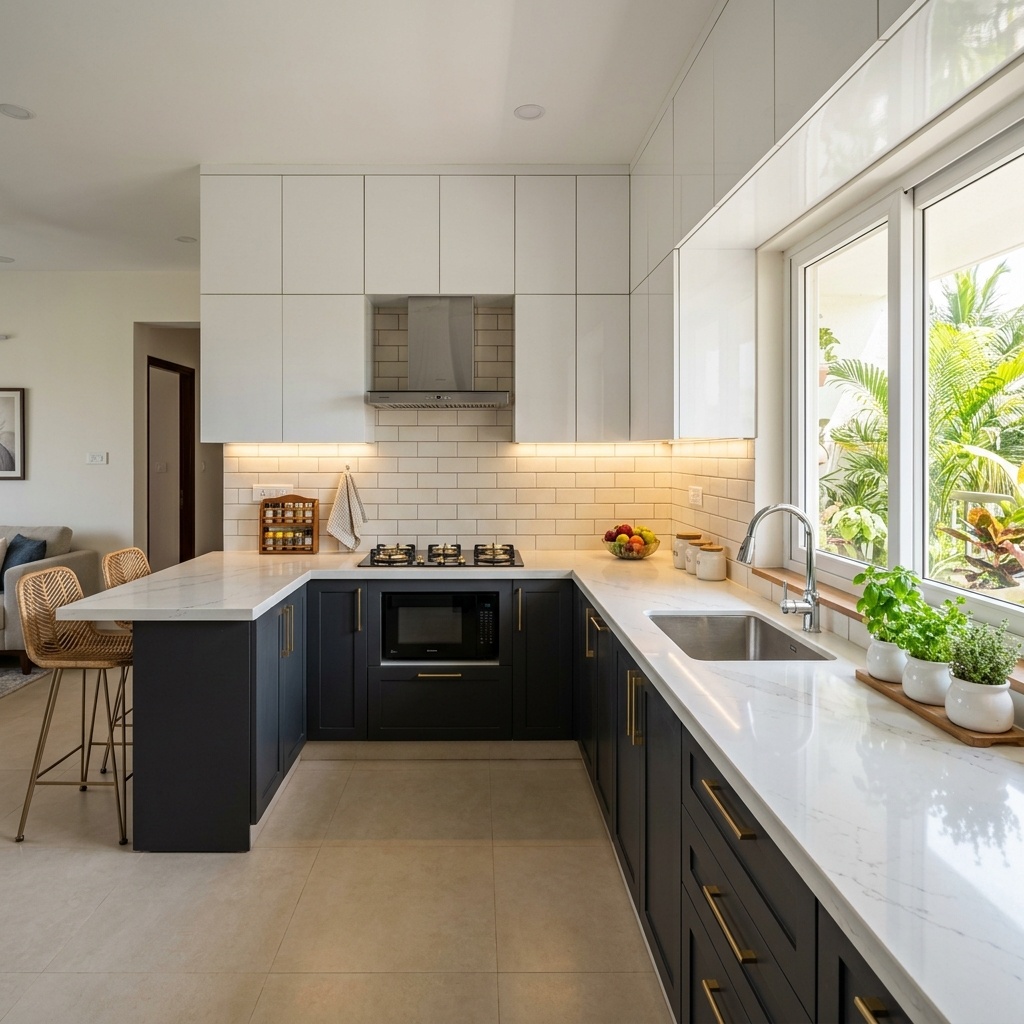
Wall cabinets mounted at 7–7.5 ft cast a shadow on the counter below when the only light source is the ceiling. Under-cabinet LED strips are mounted on the underside of wall cabinets, pointing down at the counter — eliminating this shadow completely.
| Spec | What to Choose | Why |
|---|---|---|
| LED type | SMD 5050 or SMD 2835 strip | Bright enough for task lighting; uniform distribution |
| Colour temperature | 4000K (neutral white) or 5000K (cool white) | Better colour rendering for food prep; warm white (2700K) can make food look different |
| Wattage | 9–14W per metre minimum | Under 9W per metre is too dim for task lighting |
| IP rating | IP44 or higher | Splash-resistant — near sink and cooking steam |
| Diffuser | Aluminium channel + diffuser cover | Eliminates hot spots; gives even, professional light output |
| Dimmer | Include if budget allows | Adjustable brightness for different times of day |
Cost: ₹400–₹800 per metre for quality LED strips with aluminium channel and diffuser. A standard kitchen counter run of 3 metres costs ₹1,200–₹2,400 in material. Electrician fitting is 1–2 hours of work.
Ambient Lighting: Ceiling Options Compared
| Ceiling Fixture | Best For | Light Distribution | Cost |
|---|---|---|---|
| LED panel (surface mount) | Most kitchens — bright, even, energy-efficient | Wide, very even | ₹800–₹3,000 |
| Recessed downlights (spotlights) | Modern kitchens with false ceiling — clean look | Directional — multiple spots needed | ₹400–₹1,500 per fitting |
| LED batten / tube light | Budget option — very bright, functional | Even but harsh appearance | ₹300–₹800 |
| Pendant light (above island) | Island kitchens — decorative + task light | Focused below pendant | ₹2,000–₹15,000 per pendant |
Colour Temperature: Warm vs Cool White
| Colour Temp | Look | Best Use in Kitchen |
|---|---|---|
| 2700K (warm white) | Amber-yellow — cosy, residential feel | Ambient ceiling in open-plan dining/kitchen; accent strips above cabinets |
| 3000K (soft white) | Slightly warm — balanced, welcoming | Ambient and accent in kitchens that open to dining areas |
| 4000K (neutral white) | Clean white — professional, accurate colour rendering | Best for under-cabinet task lighting; good for all-round kitchen use |
| 5000–6500K (cool/daylight) | Blue-white — very bright, alert | Under-cabinet task in food-prep-heavy kitchens; not ideal for ambient (too clinical) |
Recommendation for Indian kitchens: 4000K for under-cabinet task strips; 3000–4000K for ceiling ambient. Mixing 2700K ambient with 4000K task gives a pleasant layered effect where the counter pops while the room stays warm.
Electrical Planning: Do This Before Kitchen Installation
Plan these electrical points before kitchen cabinets are installed:
- Under-cabinet LED socket point — one per counter run, ideally inside a wall cabinet (hidden wiring)
- Chimney connection — 5A or 15A socket at chimney height, behind chimney body (hidden)
- Hob connection — if electric/induction, 15A dedicated circuit
- Microwave / OTG socket — at counter height or wall-cabinet height
- Refrigerator socket — beside or behind refrigerator position
- Counter appliance sockets — 2–3 sockets at counter height for mixer, grinder, kettle
Adding electrical points after the kitchen is installed requires opening walls, removing cabinets, and replastering — avoid this by planning all points in advance with your electrician and kitchen designer together.
Frequently Asked Questions
What is the best lighting for an Indian modular kitchen?
A three-layer approach: (1) 18–20W LED panel or 2–3 recessed downlights for ambient ceiling light, (2) Under-cabinet LED strips (4000K, 9–14W/m) for task lighting on the counter, (3) Chimney light above the hob (usually built into the chimney). This combination gives bright, shadow-free illumination on every work surface. Under-cabinet LED strips are the single most impactful addition if your budget only allows one upgrade.
Which colour temperature LED is best for kitchen?
4000K (neutral white) is the best all-round colour temperature for kitchen task lighting — it gives accurate colour rendering (important for cooking) without the harsh blue-white of daylight bulbs. For ambient ceiling lighting, 3000–4000K gives a warmer but still functional light. Avoid 2700K (warm white) for under-cabinet task strips as it can make food colours look slightly different from their actual state.
How many lights do I need in a kitchen?
Minimum for a standard 8×10 ft kitchen: one 18–20W LED ceiling panel (ambient), under-cabinet LED strips across the full counter run (task), and the built-in chimney light above the hob. Ideal: add 2–3 recessed downlights positioned above the main work zones (counter and sink) for targeted bright task light. If you have a kitchen island, add a pendant light above it for both task and aesthetic effect.
Where should under-cabinet lights be placed?
Mount under-cabinet LED strips as close to the front edge of the wall cabinet underside as possible — not pushed to the back. A strip mounted at the back of the underside shines mostly on the wall, not the counter. Mounting towards the front edge shines directly down onto the work surface. Use an aluminium channel with a diffuser to eliminate hot spots and distribute light evenly across the counter below.
Should kitchen have warm or cool lights?
Kitchens benefit from a mix: warm ambient (ceiling, 3000K) and cool task (under-cabinet and cooking zone, 4000K). Pure warm lighting (2700K throughout) looks cosy but makes it harder to judge food colour and doneness accurately. Pure cool lighting (5000K+) feels clinical. A layered approach — warm ambient + cool task — is the most functional and aesthetically pleasing for Indian kitchen and dining spaces.
How do I plan electrical points for kitchen lighting?
Plan with your electrician before kitchen cabinet installation. Key points: (1) One socket point inside each wall cabinet section for hidden under-cabinet LED wiring, (2) Dedicated socket for chimney at chimney mounting height, (3) Counter-height sockets (2–3) for appliances, (4) If using recessed downlights, decide ceiling positions and run conduit before plastering. Adding any of these after kitchen installation requires wall opening and cabinet removal.
Can I add under-cabinet lighting after the kitchen is installed?
Yes, but it's more difficult and expensive. If the cabinet base has no existing socket point, the electrician needs to run wire from the nearest source — either surface-mounted conduit (visible) or by opening the wall (disruptive). Pre-planning a socket inside one of the wall cabinets during civil work costs almost nothing and makes future LED installation plug-and-play. If your kitchen is already installed, surface conduit or a wireless battery-powered LED strip are the practical alternatives.
What wattage LED is needed for kitchen?
For a standard 8×10 ft kitchen: 18–24W LED ceiling panel for ambient (gives 200–300 lux overall). Under-cabinet: 9–14W per metre of LED strip (gives 300–500 lux on the counter surface directly below). Chimney lights: built-in, typically 3–5W halogen or LED. Counter appliance zone: no specific lighting needed beyond the above. Total kitchen lighting load for a well-lit kitchen: 30–60W — very modest on electricity.
Key Takeaways
- Three lighting layers: ambient (ceiling), task (under-cabinet + cooking zone), accent (optional decorative) — all three together give a properly lit kitchen
- Under-cabinet LED strips (4000K, 9–14W/m in aluminium channel with diffuser) are the single highest-impact kitchen lighting upgrade
- Use 4000K for task lighting and 3000K for ambient — mixing warm ceiling with cool under-cabinet is the most functional and pleasant combination
- Plan all electrical points before kitchen installation — adding them after requires wall opening and is significantly more expensive
- Total well-lit kitchen lighting load is only 30–60W — this is negligible in electricity cost while making a major daily-use difference
See These Ideas in Real Homes
Free · No Obligation
Talk to Our Design Experts
Ammon Marketing Editorial Team
Authorized Kutchina Dealer · Ranchi · Est. 2014
Our guides are written by Ranchi-based kitchen designers and appliance experts with 10+ years of on-the-ground experience. Every recommendation is based on real projects completed in Jharkhand homes — not generic advice from outside the region.