Kitchen Ventilation Guide India: Chimney vs Exhaust Fan vs Window — What Works?
Ammon Marketing
Authorized Kutchina Dealer · Ranchi
02 Jul 2026
~ read
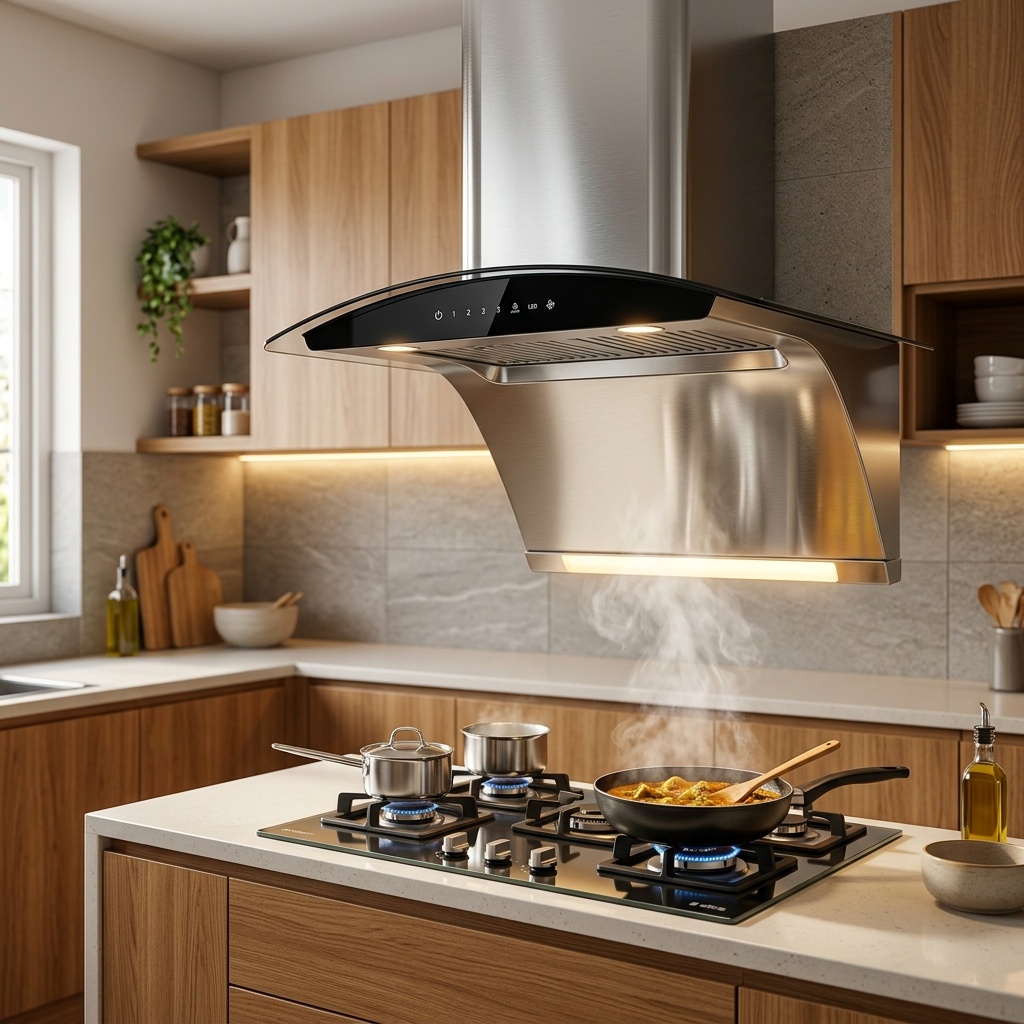
TL;DR
- A kitchen chimney is the only adequate ventilation solution for daily Indian cooking — exhaust fans and windows are insufficient for sustained smoke and grease
- An exhaust fan is only suitable for very light cooking (reheating, boiling, minimal frying) — it cannot handle daily masala frying or heavy Indian cooking
- Natural window ventilation has no active suction — it relies entirely on wind direction and is completely unreliable for cooking smoke
- A chimney directly above the hob captures smoke at the source — exhaust fans at the wall capture smoke only after it has already spread into the room
Quick Answer:For daily Indian cooking with frying, masala, and strong spices, a kitchen chimney is non-negotiable — it's the only ventilation method that captures smoke, oil vapour, and smell at the source before they spread. Exhaust fans work for light occasional cooking but fail for daily heavy cooking. Windows alone provide no reliable ventilation for cooking. If you cook Indian food regularly, install a chimney.
Full Comparison: Chimney vs Exhaust Fan vs Window
| Factor | Kitchen Chimney | Exhaust Fan | Open Window |
|---|---|---|---|
| How it works | Suction hood directly above hob captures smoke at source | Wall/window fan draws room air out | Passive — relies on wind and air pressure difference |
| Smoke capture | Excellent — captures rising smoke before it spreads | Moderate — captures only after smoke spreads into room | Poor — unreliable, depends on wind direction |
| Grease removal | Excellent — grease filter or oil collector catches grease | Poor — grease passes through fan or deposits on fan blades | None — grease settles on surfaces |
| Smell removal | Excellent (ducted) / Good (recirculating) | Moderate — removes some smell, but slowly | Depends entirely on wind and open area |
| Suitable for daily Indian frying | Yes — designed for this | No — inadequate for sustained heavy frying | No |
| Noise level | Moderate (varies by model and speed) | Moderate to high | None |
| Installation | Wall-mounted above hob, duct to exterior (ducted) or no duct (recirculating) | Wall or window cutout | None — already present |
| Cost | ₹8,000–₹30,000+ | ₹1,500–₹6,000 | Free (if window exists) |
| Running cost (electricity) | Low — 150–250W | Low — 30–75W | None |
| Maintenance | Monthly auto-clean cycle; annual deep clean | Periodic blade cleaning | Window cleaning |
Why an Exhaust Fan Is Not Enough for Indian Cooking
An exhaust fan is mounted on the wall — typically 6–7 ft high, at the far end of the kitchen from the hob. The smoke from frying must travel across the entire kitchen, rise to the wall fan height, and then get drawn out. During this journey, it:
- Deposits oil and grease on walls, ceiling, and cabinets it passes over
- Spreads cooking smell through the room before being partially captured
- In a closed kitchen with an exhaust fan only, smell accumulates significantly during a 30-minute frying session
- The fan blades collect grease rapidly with Indian cooking — a clogged exhaust fan loses 50–70% of its already-limited effectiveness within months
A chimney sits directly above the hob and captures smoke as it rises — before it reaches the cabinet zone. The difference in real kitchen conditions is dramatic: with a chimney, there is minimal residual smell 5 minutes after cooking. With only an exhaust fan after a frying session, the smell can persist for 30–60 minutes.
When an Exhaust Fan IS Adequate
| Cooking Type | Exhaust Fan Adequate? | Chimney Needed? |
|---|---|---|
| Daily heavy Indian cooking (frying, masala, curries) | No | Yes — essential |
| Daily light cooking (boiling, steaming, reheating) | Yes — sufficient | Optional upgrade |
| Occasional cooking (1–2 times per week, light meals) | Yes | Optional |
| Open kitchen with good cross-ventilation | Marginal for light cooking only | Still recommended for smoke capture |
| Hostel room / single occupant light cooking | Yes | Optional |
Frequently Asked Questions
Is a kitchen chimney necessary for Indian cooking?
Yes — for daily Indian cooking involving frying, masala, and strong spices, a chimney is necessary, not optional. It is the only ventilation method that captures smoke and grease at the source (directly above the hob) before it spreads into the kitchen and living areas. Without a chimney, oil vapour deposits on walls, cabinets, and ceiling over months and years — causing permanent staining and requiring costly deep cleaning.
Can I use exhaust fan instead of chimney in kitchen?
An exhaust fan is a poor substitute for a chimney in Indian kitchens. Exhaust fans are wall-mounted and capture smoke only after it has spread across the room — meaning grease and smell already coat your cabinets and walls before the fan removes them. For very light cooking (reheating, occasional boiling), an exhaust fan is sufficient. For daily Indian cooking with frying and masala, only a chimney positioned directly above the hob is adequate.
What is the difference between kitchen chimney and exhaust fan?
A kitchen chimney is a suction hood mounted directly above the cooking hob — it captures smoke, oil vapour, and smell right at the source as they rise. An exhaust fan is a wall or window fan that draws room air out. The critical difference is capture point: a chimney captures at the hob, an exhaust fan captures after smoke has already spread into the room. For Indian cooking intensity, this difference is decisive.
Which is better — ducted or ductless chimney for ventilation?
Ducted (external vent) chimney is always better — smoke, grease, and smell exit the home completely. Ductless (recirculating) chimneys filter and recirculate air back into the kitchen — they remove about 60–70% of smoke and smell vs 95%+ for ducted. If an external duct route is available (wall to exterior, or ceiling to outside), always choose ducted. If no duct is possible (interior apartment kitchen), choose an auto-clean filterless recirculating model for the best recirculating performance.
How much ventilation does an Indian kitchen need?
For a closed Indian kitchen doing daily cooking, the minimum chimney suction is 10× the kitchen volume in m³/hr. For a standard 3×3×2.7m kitchen (27 m³), that's 270 m³/hr minimum — which any standard chimney (1,200 m³/hr) far exceeds. The 1,200 m³/hr figure is the Indian standard for closed kitchens. For open kitchens or heavy daily cooking, 1,500 m³/hr is recommended.
Can open window replace kitchen chimney?
No. Open windows provide passive ventilation that depends entirely on wind direction, window size, and pressure differential. There is no active suction to draw smoke toward the window. In many Indian apartments, the kitchen window faces a corridor or another wall — making even passive ventilation unreliable. Open windows can supplement a chimney for fresh air circulation but cannot replace it for smoke and grease capture.
What happens if you cook Indian food without a chimney?
Over time without a chimney: (1) Oil vapour deposits build up on cabinet surfaces, walls, and ceiling — turning cream shutters yellow-brown within 12–18 months of daily frying, (2) Grease accumulates on top of wall cabinets and the ceiling above the hob, (3) Cooking smell permeates soft furnishings in adjacent rooms (especially in open kitchens), (4) The carcass board behind the hob absorbs grease and slowly degrades. A chimney prevents all of these by capturing vapour before it spreads.
Is it worth installing chimney in rental apartment?
Yes — a chimney is one of the few kitchen items that is genuinely portable. A wall-mounted chimney can be removed and reinstalled in your next home at a fraction of the purchase cost (labour only, ₹1,500–₹3,000). Unlike modular kitchen cabinets, the chimney leaves only 4 wall drill holes when removed — easily patched. Get landlord permission for wall mounting, then take the chimney with you when you move. It is one of the best portable kitchen investments for renters.
Key Takeaways
- A chimney is the only adequate ventilation for daily Indian cooking — not an optional upgrade
- Exhaust fans are wall-mounted and capture smoke only after it spreads; chimneys capture at the hob before it spreads — a fundamental difference in real-world performance
- Open windows are passive and unreliable — they cannot substitute for active suction ventilation
- Ducted chimney (external vent) is always more effective than ductless/recirculating — choose ducted whenever an external duct route exists
- Chimneys are portable for renters — removable from one home and re-installable in the next, making them a sensible investment even in rental apartments
See These Ideas in Real Homes



Free · No Obligation
Talk to Our Design Experts
Ammon Marketing Editorial Team
Authorized Kutchina Dealer · Ranchi · Est. 2014
Our guides are written by Ranchi-based kitchen designers and appliance experts with 10+ years of on-the-ground experience. Every recommendation is based on real projects completed in Jharkhand homes — not generic advice from outside the region.