Modular Kitchen for Small Kitchen & 2 BHK Flats: Space-Saving Designs That Work
Ammon Marketing
Authorized Kutchina Dealer · Ranchi
02 Jul 2026
~ read
TL;DR
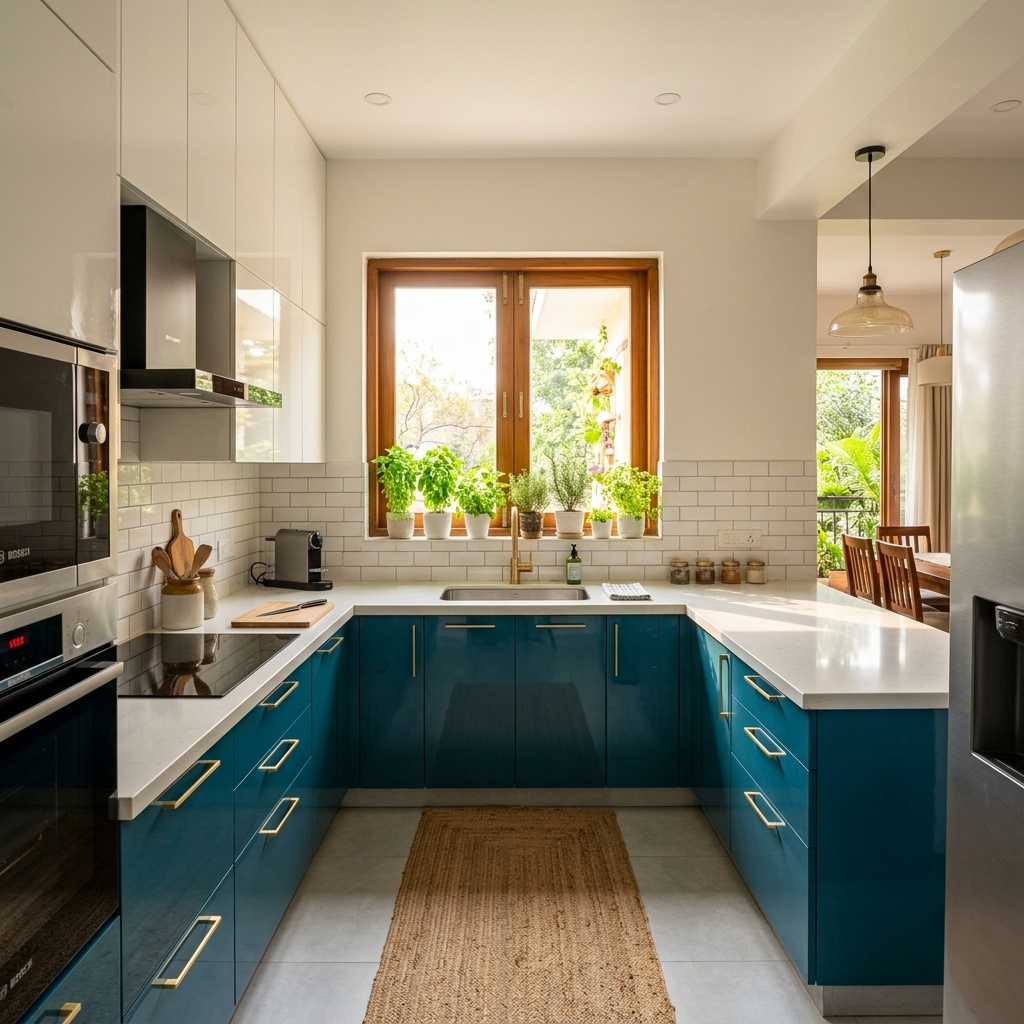
- In a small kitchen, L-shaped with floor-to-ceiling storage gives the best storage-to-footprint ratio
- Going floor-to-ceiling with wall cabinets adds 30–40% more storage without touching the floor area
- A 450mm-deep countertop (vs standard 600mm) frees 6 inches of walking space in narrow kitchens
- The biggest waste in small kitchens: dead corners — a carousel unit recovers 4+ sq ft of usable storage
Quick Answer: The best modular kitchen for a small space (under 80 sq ft, standard 2 BHK) is an L-shaped layout with floor-to-ceiling wall cabinets, pull-out accessories in every base unit, and a 450mm countertop depth instead of the standard 600mm. Skip the island, open display shelves, and decorative accessories — in a small kitchen, every module must earn its space with storage.
Most modular kitchen showrooms display kitchens in large, airy spaces that make even modest designs look generous. When you bring the same plan home to a 7×9 ft kitchen in a Ranchi 2 BHK flat, it suddenly feels cramped. Small kitchens need different thinking from the start.
Why Small Kitchens Need Different Planning
A standard modular kitchen is designed around 600mm-deep base cabinets, 300mm-deep wall cabinets, and a 720mm-high counter. These dimensions work for kitchens with 36+ inches of aisle width. In a small kitchen, the same standard dimensions can leave you with less than 30 inches of walking space — uncomfortable for one person and impossible for two.
The solution is not smaller cabinets — it's smarter cabinet choices, adjusted depths where possible, and accessories that recover dead space that standard planning wastes.
Best Layout for a Small Kitchen
| Kitchen Size | Best Layout | Why | Storage Potential |
|---|---|---|---|
| 6×6 ft or smaller | Straight (single wall) | Only one wall available; any other layout blocks movement | Limited — focus on vertical |
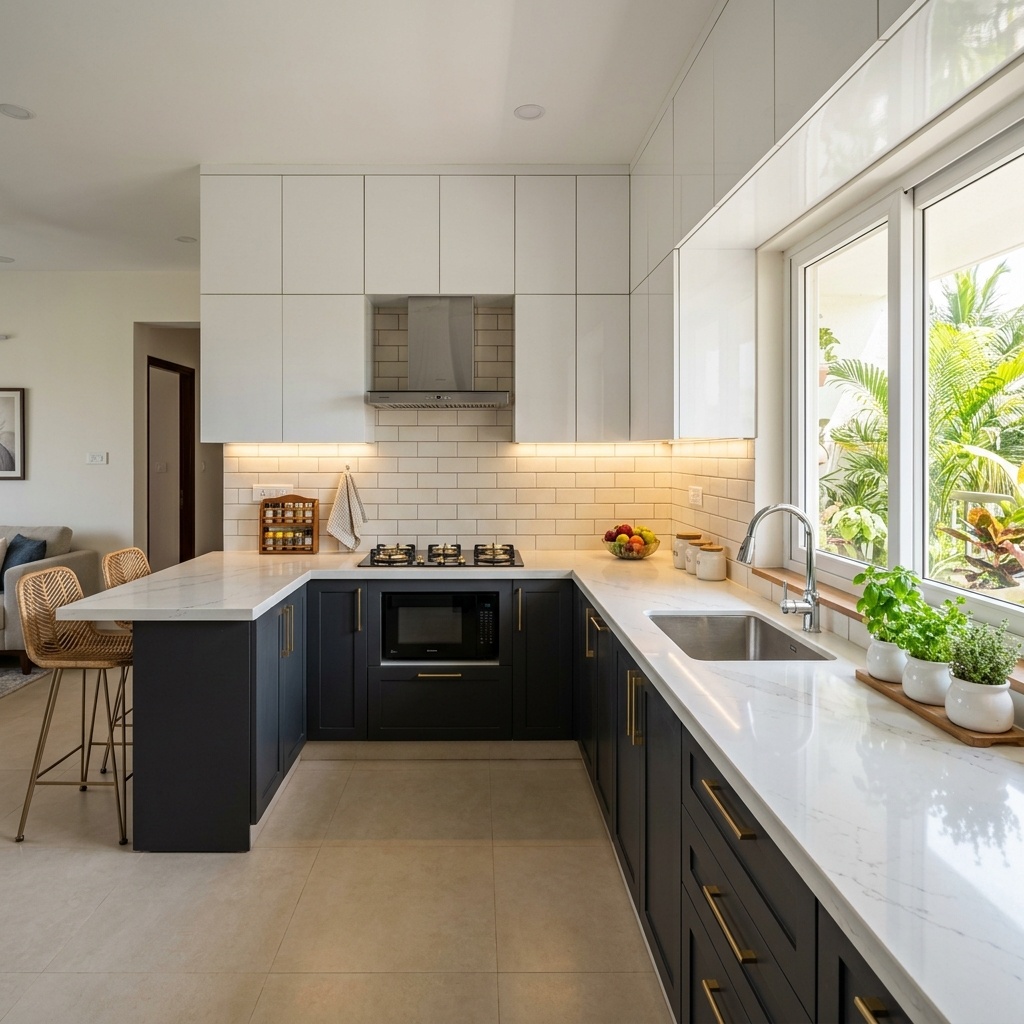
| 6×8 ft to 7×9 ft | L-shaped | Two walls give much better storage without blocking the aisle | Good with floor-to-ceiling |
| 7×10 ft (narrow, long) | Parallel or L-shaped | Parallel uses both long walls efficiently; L uses one long + one short | Very good with pull-outs |
| 8×10 ft | L-shaped (standard) | Standard fit — allows comfortable 36-inch aisle | Good to excellent |
Going Vertical: The Floor-to-Ceiling Strategy
Most kitchens have 9–10 ft ceiling height. Standard wall cabinets go up to about 7.5 ft from the floor, leaving 18–30 inches of dead space above them. In a small kitchen, this is wasted real estate.
Floor-to-ceiling cabinets — placing an additional loft unit above your standard wall cabinets — add 30–40% more storage without changing a single floor dimension. The upper zone (above 7 ft) is ideal for rarely-used items: large vessels, festival crockery, bulk grocery storage.
Pro tip: For items stored above 6.5 ft, use a small step stool kept in the base cabinet pull-out — not a chair. This keeps the upper zone practical. Use the upper zone for light but large items (serving platters, large vessels) — not heavy items like pressure cookers.
5 Smart Accessories That Transform Small Kitchens
| Accessory | What It Does | Space Recovered | Cost Range |
|---|---|---|---|
| Corner Carousel | Rotating shelves that bring deep corner items to you | Recovers 4+ sq ft of dead corner space | ₹4,000–₹10,000 |
| Full-Extension Tandem Box | Smooth-slide drawer with internal dividers, goes full depth | 20% more usable drawer volume | ₹3,000–₹8,000 per unit |
| Pull-Out Base Unit | Converts deep base cabinets into pull-out rack systems | Eliminates dead depth in base units | ₹4,000–₹12,000 |
| Under-Sink Organiser | Maximises the awkward under-sink cabinet space | Doubles under-sink usable area | ₹2,000–₹5,000 |
| Loft Unit (above wall cabinets) | Adds a cabinet in the dead zone above standard wall cabinets | +30–40% wall storage | ₹8,000–₹20,000 |
Counter Depth: 450mm vs 600mm
Standard base cabinets are 600mm (24 inches) deep. In a kitchen with a 7 ft (84 inch) aisle, this leaves 24 inches of walking clearance on a single-counter run — comfortable for one person. With counters on both sides (parallel layout), clearance drops to 36 inches which works, but barely.
Reducing countertop depth to 450mm (18 inches) on the secondary wall in a narrow parallel or L-shaped kitchen frees an extra 6 inches of aisle width. The tradeoff: slightly less countertop depth for prep work on that side. For wall cabinets, 300mm depth is standard — this doesn't need changing.
What NOT to Do in a Small Kitchen
- Open shelves instead of wall cabinets: They collect grease, dust, and make the kitchen look cluttered faster. In a small kitchen, closed cabinets keep everything out of sight and easier to clean.
- Dark colours: Dark finishes absorb light and make small spaces feel smaller. Stick to white, cream, or light grey for the cabinets.
- Decorative accessories over storage: A fruit basket, cookbook shelf, or pot rack looks great in a large kitchen. In a small kitchen, they take up space that storage could use.
- An island: Islands need 1.2 m of clearance on all sides. In a kitchen under 120 sq ft, an island simply blocks movement.
- Ignoring the chimney position: In small kitchens, the chimney must be directly above the hob. A chimney that's off-centre is both ineffective and wastes wall cabinet space around it.
Frequently Asked Questions
What is the best modular kitchen for a small space?
L-shaped layout with floor-to-ceiling wall cabinets and pull-out accessories in the base units. Use 450mm depth on the secondary wall if the aisle is tight. Keep colours light (white, cream, pale grey), skip open shelving, and invest in a corner carousel to recover dead corner space.
Can I have a modular kitchen in a 6×8 ft kitchen?
Yes. A 6×8 ft kitchen (48 sq ft) can fit an L-shaped layout with 6 ft on one wall and 5 ft on the other (minus corner unit). You'll get approximately 8–9 running feet of base cabinets and 7–8 running feet of wall cabinets. It's tight but workable — focus on vertical storage and pull-out accessories.
Which layout is best for a small modular kitchen?
L-shaped is best for small kitchens with two adjacent walls available. It gives more storage than straight and maintains a comfortable work triangle. Straight (single wall) is only necessary when there's genuinely only one usable wall. Parallel works in narrow-long kitchens with at least 3 ft of aisle clearance between the two counters.
How do I maximize storage in a small modular kitchen?
Three things: (1) Go floor-to-ceiling with wall cabinets — the zone above standard cabinet height is free storage. (2) Use pull-out accessories in every base unit — tandem drawers, pull-out racks, corner carousels. (3) Use every vertical surface — a wall-mounted spice rack, knife block, or utensil holder keeps the counter clear.
What cabinet depth is best for a small kitchen?
Standard base cabinet depth is 600mm (24 inches). If your aisle width is less than 36 inches with standard cabinets on both sides, reduce the secondary wall cabinets to 450mm depth. Wall cabinets at 300mm depth are standard and work well in small kitchens — don't reduce these as it limits storage significantly.
Is floor-to-ceiling storage worth it in a small kitchen?
Yes — it's one of the best investments in a small kitchen. The zone above standard wall cabinet height (roughly 7.5–10 ft from floor) is completely free space in most kitchens. A loft unit or tall cabinet here adds 30–40% more storage at a fraction of what expanding the kitchen footprint would cost.
How do I plan a modular kitchen for a 2 BHK flat in Ranchi?
Most 2 BHK kitchens in Ranchi housing societies are 7×9 ft to 8×10 ft. An L-shaped layout fits most of these. Priority order: (1) Fix chimney position above hob, (2) Decide sink position near existing plumbing, (3) Plan L-shape around these fixed points, (4) Go floor-to-ceiling on wall cabinets, (5) Add corner carousel and pull-outs. Book a free site visit from Ammon Marketing for precise measurements.
What are must-have accessories for a small modular kitchen?
Four essentials: (1) Corner carousel — recovers 4+ sq ft of dead corner space, (2) Full-extension tandem drawer boxes — much more accessible than standard shelves, (3) Loft unit above standard wall cabinets — adds 30% more storage, (4) Under-cabinet LED strip lighting — makes the counter feel larger by eliminating shadows.
Key Takeaways
- L-shaped layout with floor-to-ceiling storage is the best solution for most Indian small kitchens — it uses both walls and exploits vertical height
- Going floor-to-ceiling adds 30–40% more storage without changing the kitchen's footprint — the single best investment in a small kitchen
- Pull-out accessories (corner carousel, tandem drawers, under-sink organiser) recover dead space that standard cabinets waste
- Avoid dark colours, open shelves, and decorative items that sacrifice storage — in a small kitchen, function comes first
- For Ranchi 2 BHK kitchens (typically 7×9 to 8×10 ft), a free professional site visit is the most important first step — dimensions and existing plumbing determine everything
See These Ideas in Real Homes
Free · No Obligation
Talk to Our Design Experts
Ammon Marketing Editorial Team
Authorized Kutchina Dealer · Ranchi · Est. 2014
Our guides are written by Ranchi-based kitchen designers and appliance experts with 10+ years of on-the-ground experience. Every recommendation is based on real projects completed in Jharkhand homes — not generic advice from outside the region.