Open Kitchen vs Closed Kitchen: Which Is Better for Indian Homes?
Ammon Marketing
Authorized Kutchina Dealer · Ranchi
02 Jul 2026
~ read
TL;DR
- For Indian cooking (daily frying, strong spices, oil), a closed kitchen is more practical — smoke and smell stay contained
- Open kitchens work well for families who mostly cook light meals or have very powerful chimneys
- Semi-open (glass partition or breakfast counter) gives the visual benefit without smoke and grease spreading
- Converting a closed kitchen to fully open in an apartment requires a structural check — not all walls can be removed
Quick Answer: For Indian cooking habits, a closed kitchen is more practical — it contains cooking smoke, oil vapour, and strong food smells within the kitchen zone. Open kitchens suit families that cook light or entertaining-focused households. The best middle ground is a semi-open kitchen with a glass partition or breakfast bar — you get visual connectivity without smoke and grease reaching your living room.
Open kitchens dominate Instagram reels and interior design showrooms. They look spacious, modern, and social. But Instagram photos don't show the smell of frying fish spreading through the living room, or the film of cooking oil that settles on your sofa cushions after six months of open-kitchen cooking. This guide gives you the honest picture.
What Is Open vs Closed Kitchen?
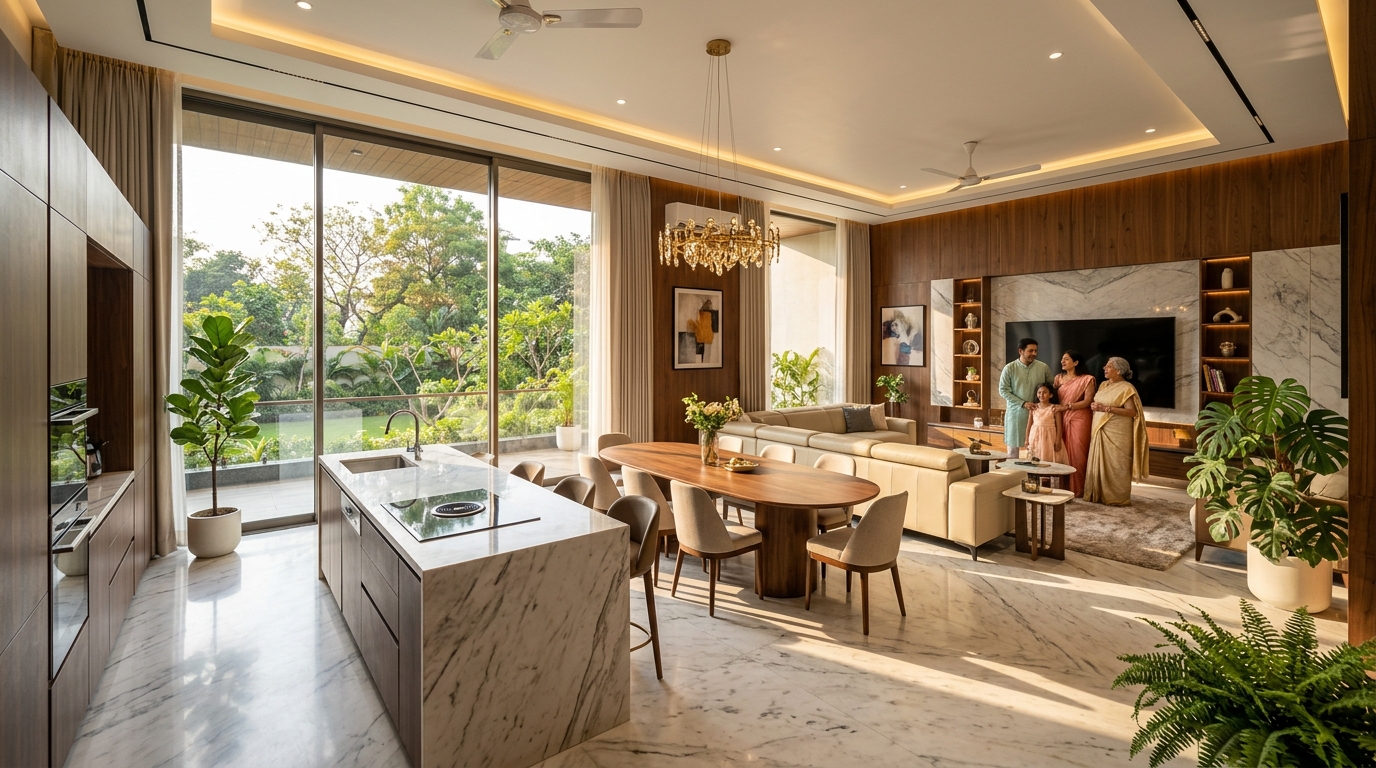
Open kitchen: No wall separating the kitchen from the living or dining area. The cooking zone flows directly into the main living space. Popular in modern apartments and designed to make small homes feel larger.
Closed kitchen: A fully enclosed kitchen with a dedicated wall (or walls) and a door separating it from the rest of the home. The traditional layout in Indian homes for decades.
Full Comparison
| Factor | Open Kitchen | Closed Kitchen |
|---|---|---|
| Visual Feel | Spacious, modern, social | Contained, defined, traditional |
| Cooking Smoke & Smell | Spreads to living room — visible and smellable | Stays in kitchen with good chimney |
| Grease on Furniture | Yes — sofa, curtains, TV accumulate grease over time | Minimal to none |
| Chimney Needed | 1,500+ m³/hr to manage open-air dissipation | Standard 1,200+ m³/hr is sufficient |
| Suitability for Indian Cooking | Works for light cooking; challenging for daily frying | Best suited for heavy daily Indian cooking |
| Cooking Noise | Reaches living area — mixers, pressure cookers audible | Mostly contained |
| Maintenance | More surfaces affected by cooking residue | Easier to keep cooking mess isolated |
| Space Perception | Makes home feel larger, especially in compact flats | Defined space — kitchen feels separate |
| Social / Entertaining | Host while cooking, family interaction during meals | Less interaction unless you step out |
| Structural Changes (apartments) | May require wall removal — structural check needed | No changes needed |
| Relative Cost | Higher if wall needs to be removed or modified | Standard — no extra structural cost |
| Resale Value | Slightly higher in metros; neutral in Tier 2 cities | Neutral — preferred by traditional buyers |
Open Kitchen: Who It Suits
- Families that cook mostly light meals (sandwiches, pasta, salads, quick stir-fries) — minimal heavy frying
- Couples or small households where entertaining and social cooking are a priority
- Homes with a very powerful chimney system (1,500+ m³/hr) positioned directly above the hob
- Smaller apartments where removing a wall genuinely makes the home feel significantly more livable
- Homeowners willing to clean the living area surfaces (shelves, sofa backs, curtains) more frequently
Closed Kitchen: Who It Suits
- Families that cook daily Indian meals — tadka, frying, curries with strong spices
- Homes where cooking smell is culturally significant (fish curry, mutton, strong spices) and you want it contained
- Households with young children where kitchen access needs to be controlled
- Anyone who doesn't want to deep-clean their living room furniture to remove cooking grease
- Most Jharkhand households — traditional cooking styles and family structures suit a closed kitchen
The Semi-Open Kitchen: The Practical Indian Solution
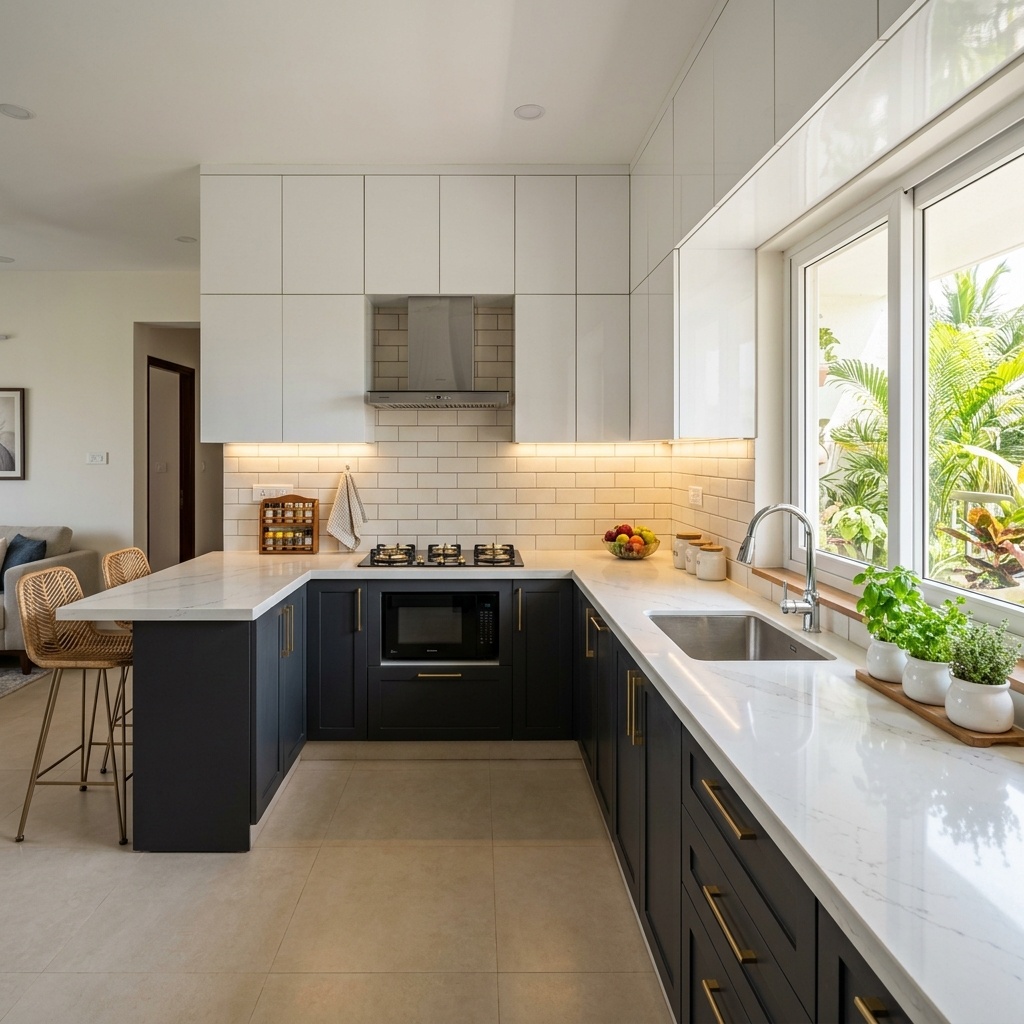
A semi-open kitchen gives you the visual spaciousness of an open kitchen while keeping most of the smoke and smell contained. The three main approaches:
- Glass partition: A floor-to-ceiling or half-height glass panel between kitchen and dining area. Visual connectivity without air connectivity. Frosted or fluted glass adds partial privacy while still allowing light to pass.
- Breakfast counter / bar divider: A raised counter at the kitchen boundary serves as a partial divider and dining surface. No full wall removal needed — works as a peninsular extension of the kitchen counter.
- Sliding or folding door: Keep the wall but add a wide sliding glass or wooden door. Open it when entertaining, close it when cooking heavily. Full flexibility with zero compromise.
Recommended for most Indian homes: The sliding glass door or glass partition is the best compromise — you can see into the kitchen from the living area, natural light passes through, but cooking smoke and smell are contained when the door is closed. It also requires no structural changes, making it feasible in almost any apartment.
Before removing a wall in your apartment: Always get a structural engineer's assessment. In multi-story apartment buildings, kitchen walls are often load-bearing or shear walls — removing them without assessment can compromise the building's structure. Get written clearance before any demolition work begins.
Frequently Asked Questions
Which is better — open kitchen or closed kitchen for Indian homes?
For most Indian families that cook daily traditional meals (frying, curries, strong spices), a closed kitchen is more practical. It contains smoke, smell, and grease within the kitchen. A semi-open kitchen with a glass partition gives you the aesthetic of an open kitchen with the practical benefits of a closed one.
Is open kitchen suitable for Indian cooking?
It depends on cooking frequency and style. For daily heavy Indian cooking — tadka, frying, curries — an open kitchen means smoke, oil vapour, and strong smells spread through the living room, settle on curtains and furniture, and require more frequent whole-home cleaning. For light cooking or families that cook 1–2 times weekly, open kitchen works fine.
Can a chimney handle smoke in an open kitchen?
A standard chimney (1,200 m³/hr) is designed for a closed kitchen where it can capture rising smoke. In an open kitchen, you need significantly higher suction — 1,500 m³/hr or more — because smoke disperses before the chimney can capture all of it. Even with a powerful chimney, oil vapour and faint smells will still reach the living room during heavy cooking.
What is a semi-open kitchen?
A semi-open kitchen uses a partial barrier — glass partition, breakfast counter, or sliding door — to create visual connectivity between the kitchen and living area while still containing most cooking smoke and smell. It's the most popular choice in new apartments in India because it gives the open-kitchen look without the practical problems of fully open-plan cooking.
How much does it cost to convert a closed kitchen to open?
Converting to open requires wall removal, which in India costs ₹15,000–₹50,000 for the structural work, plastering, and finishing. If the wall has electrical or plumbing inside it, add another ₹10,000–₹25,000. A semi-open conversion (glass partition + counter divider) is cheaper: ₹20,000–₹60,000 depending on materials and size.
Is an open kitchen safe for Indian homes with children?
Open kitchens with young children need careful planning. Without a door or gate, children can freely access hot surfaces, sharp objects, and gas lines. A half-height counter divider or a retractable gate at the kitchen entrance provides the open visual while adding a safety barrier. Closed kitchens with baby gates are the safest option for households with toddlers.
Does an open kitchen increase home value in India?
In metros (Mumbai, Bengaluru, Hyderabad), open kitchens generally appeal to younger buyers and can add perceived value. In Tier 2 cities like Ranchi, buyer preferences are more mixed — many traditional Indian families prefer a closed kitchen. A well-executed semi-open kitchen with quality modular fitting tends to add more resale value than a rough wall-removal open kitchen.
Which type of kitchen is trending in India 2026?
Semi-open kitchens are the biggest trend in Indian homes for 2026 — specifically the glass partition design or breakfast counter approach. Fully open plan is trending in premium metro apartments. In Tier 2 cities and family homes, the closed kitchen remains most common, but with modern modular designs, better lighting, and colour-updated finishes.
Key Takeaways
- For daily heavy Indian cooking, a closed kitchen is the practical choice — it contains smoke, smell, and cooking grease within the kitchen zone
- Open kitchens suit light-cooking households, couples who entertain frequently, or homes where the kitchen is used less intensively
- The semi-open kitchen (glass partition, breakfast counter, or sliding door) is the best compromise — visual openness with practical containment
- Never remove an apartment wall without a structural engineer's written assessment — many kitchen walls in multi-story buildings are load-bearing
- A powerful chimney (1,500+ m³/hr) is non-negotiable for open kitchens — a standard chimney is not designed to handle open-air smoke dispersal
See These Ideas in Real Homes
Free · No Obligation
Talk to Our Design Experts
Ammon Marketing Editorial Team
Authorized Kutchina Dealer · Ranchi · Est. 2014
Our guides are written by Ranchi-based kitchen designers and appliance experts with 10+ years of on-the-ground experience. Every recommendation is based on real projects completed in Jharkhand homes — not generic advice from outside the region.