Parallel (Galley) Kitchen Design Guide: Pros, Cons & Layout Tips for Indian Homes
Ammon Marketing
Authorized Kutchina Dealer · Ranchi
02 Jul 2026
~ read
TL;DR
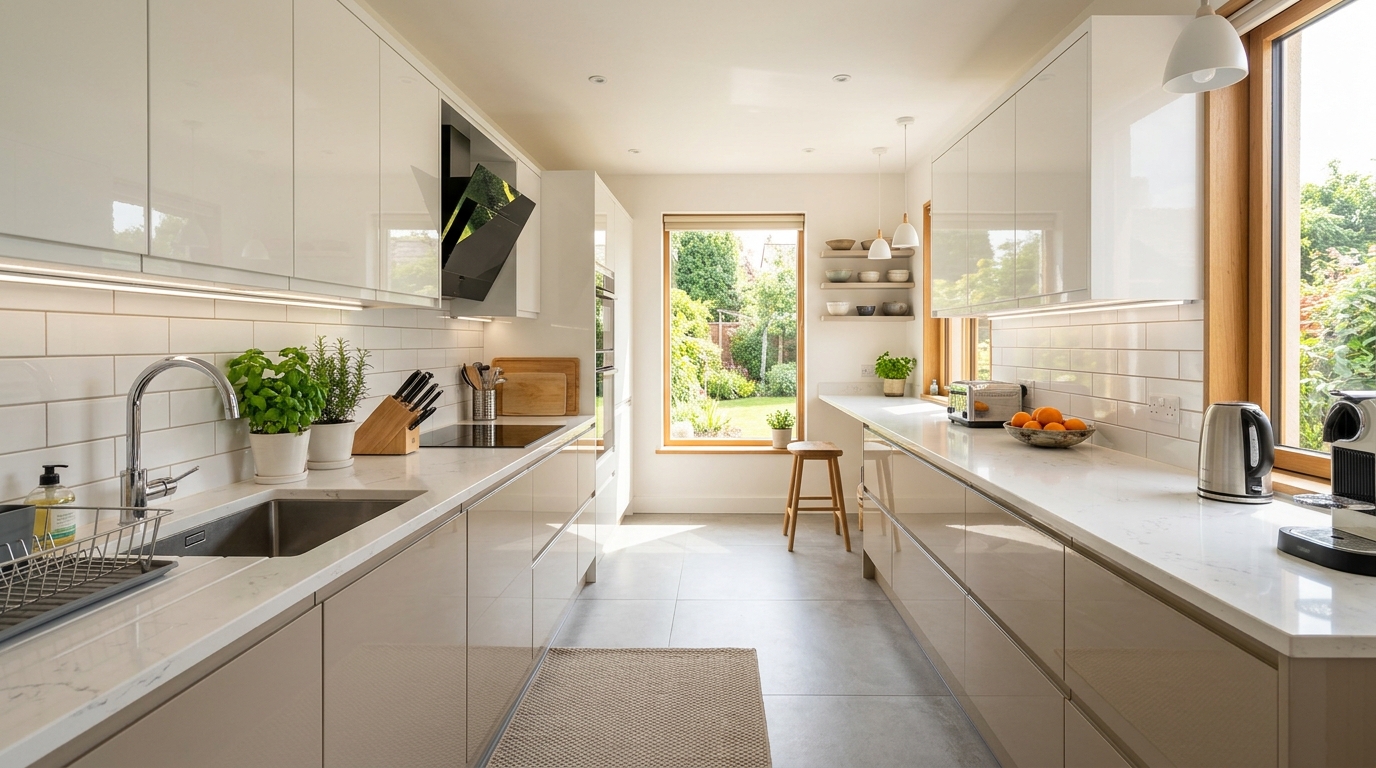
- Parallel (galley) kitchen has cabinets on two opposite walls — best for narrow, long kitchens where an L-shape isn't possible
- Minimum aisle width between parallel runs: 900mm (3 ft) — 1,050–1,200mm is ideal for one cook
- Best workflow of any layout — everything is within 2–3 steps; no corner turns needed
- Works well in kitchens 7–9 ft wide and 10–14 ft long — very common in Indian apartment buildings
Quick Answer:A parallel kitchen (also called galley kitchen) puts counter and cabinets on two facing walls, with an aisle between them. It is highly efficient for one cook — everything is within arm's reach — and provides excellent storage on both sides. It suits long, narrow Indian kitchens better than any other layout. Minimum aisle: 900mm. Ideal: 1,050–1,200mm. If the aisle drops below 900mm, the layout becomes claustrophobic and impractical.
Parallel Kitchen vs Other Layouts
| Factor | Parallel (Galley) | L-Shape | U-Shape |
|---|---|---|---|
| Minimum kitchen size | 7 ft × 10 ft | 8 ft × 10 ft | 9 ft × 11 ft |
| Workflow efficiency | Excellent — everything in a straight line | Good | Excellent but requires more movement |
| Storage (cabinet metres) | High — both walls used | Medium | Maximum |
| Suitable for one cook | Excellent | Good | Good |
| Suitable for two cooks | Poor — aisle is shared | Better — one cook per arm | Best |
| Counter space | Medium to high | Medium | Maximum |
| Natural light | Less — one window wall only | Better — corner window possible | Less |
| Cost relative | Lowest (two straight runs) | Medium | Highest |
Optimal Parallel Kitchen Zone Planning
| Wall | Recommended Zone | Why |
|---|---|---|
| Wall A (window side / better-lit side) | Sink + prep counter | Natural light for washing and chopping; drain connection usually on this wall |
| Wall A continuation | Refrigerator at end of run | Fridge at entry end of the galley — accessed first before cooking starts |
| Wall B (opposite side) | Hob + cooking counter | Separates wet (sink) and dry (cooking) zones; chimney on this wall |
| Wall B continuation | Storage cabinets + microwave | Non-active storage on the cooking side |
| Aisle clearance | Minimum 900mm, ideally 1,050mm | Allows working at both counters with body clearance |
Frequently Asked Questions
What is a parallel kitchen layout?
A parallel kitchen (also called galley kitchen) has kitchen cabinets, counters, and appliances arranged on two opposite-facing walls, with a central aisle between them. Unlike an L-shape (two adjacent walls) or U-shape (three walls), a parallel kitchen runs in a straight line on both sides. It is particularly well-suited to long, narrow kitchens — common in Indian apartments — where an L-shape isn't possible due to limited room width.
What is the minimum size for a parallel kitchen?
Minimum 7 ft (2,100mm) wide and 10 ft (3,000mm) long for a functional parallel kitchen. The width accommodates 600mm base cabinet depth on each side (total 1,200mm) plus a 900mm aisle (minimum comfortable clearance). For two cooks working simultaneously, 8 ft (2,400mm) width is needed to achieve a 1,200mm aisle. Length of 10 ft provides approximately 3 metres of cabinet run on each side — sufficient for a complete kitchen.
What are the disadvantages of a parallel kitchen?
Three main disadvantages: (1) Not suitable for two cooks simultaneously — the single aisle creates a traffic conflict when two people are working at opposite counters, (2) Closed and narrow feel — parallel kitchens have no corner counter, which makes the space feel tunnel-like, especially if the aisle is below 1,050mm, (3) No dead-corner storage advantage — L and U-shape layouts have corners that can be utilised with carousels; parallel layouts have no corners. These are rarely dealbreakers — the efficiency for one cook and maximum storage more than compensate in Indian single-cook households.
Is parallel kitchen good for Indian cooking?
Yes — the parallel kitchen layout is one of the most efficient for Indian cooking, particularly for single-cook households. With sink and prep on one wall, and hob and cooking on the opposite wall, all three cooking phases (wash → prep → cook) happen within 2–3 steps with no corner turns. The two-wall layout also provides maximum running feet of storage in a given kitchen area — important for Indian kitchens with heavy vessel and spice storage requirements.
What is the ideal aisle width for a parallel kitchen?
1,050–1,200mm (3.5–4 ft) is the ideal aisle width for a parallel kitchen with one cook. This allows: comfortable working at either counter without feeling cramped, easy 180-degree turn between the two counters while holding a pot, and clearance for a second person to pass through while the cook is working. Minimum acceptable: 900mm (3 ft). Below 900mm, the kitchen feels claustrophobic and is impractical for Indian cooking with large pots.
What is the cost of a parallel kitchen?
A parallel kitchen is typically the most cost-effective modular kitchen layout — two straight runs with no corner units. For a 10-12 running-foot parallel kitchen (5–6 ft on each wall), cost in Ranchi 2026: ₹1.8–₹3.5 lakh depending on material and finish. Compared to an equivalent L-shape kitchen, the parallel layout saves ₹15,000–₹35,000 by eliminating one corner unit (carousel) and having simpler installation geometry.
Can I have an island in a parallel kitchen?
Only if the parallel kitchen is wide enough — minimum 14 ft (4,200mm) total width to fit a parallel kitchen plus a central island with 1,200mm clearance on both sides of the island. This is very rarely achievable in Indian apartments. A rolling kitchen cart (portable island) is a better alternative for parallel kitchens wanting some island functionality — it can be placed in the aisle when needed and moved to the dining area for serving.
How do I improve a narrow parallel kitchen?
Five ways to improve a narrow parallel kitchen: (1) Use lighter cabinet colours and reflective finishes (acrylic) to make the space feel larger, (2) Install under-cabinet LED strips — lighting the counter surface reduces the tunnel feeling, (3) Use open shelves on one side instead of upper wall cabinets — creates visual breathing room, (4) Install a sliding kitchen door instead of swing to free the full width of the aisle at the entrance, (5) Match the floor tile to the cabinet colour in a neutral tone — visual continuity reduces the sense of enclosure.
Key Takeaways
- Parallel kitchen is the best layout for long, narrow Indian kitchens — two straight runs with maximum storage and workflow efficiency
- Minimum aisle width: 900mm — ideal: 1,050–1,200mm for comfortable solo cooking
- Parallel layout suits single-cook households best — aisle is a shared bottleneck for two simultaneous cooks
- Most cost-effective modular kitchen layout — no corner units or complex module planning
- Zone planning: sink + prep on the window wall; hob + cooking on the opposite wall — separates wet and dry zones efficiently
See These Ideas in Real Homes
Free · No Obligation
Talk to Our Design Experts
Ammon Marketing Editorial Team
Authorized Kutchina Dealer · Ranchi · Est. 2014
Our guides are written by Ranchi-based kitchen designers and appliance experts with 10+ years of on-the-ground experience. Every recommendation is based on real projects completed in Jharkhand homes — not generic advice from outside the region.