Plywood vs MDF vs HDHMR vs BWP: Which Board Is Best for Modular Kitchen Cabinets?
Ammon Marketing
Authorized Kutchina Dealer · Ranchi
02 Jul 2026
~ read
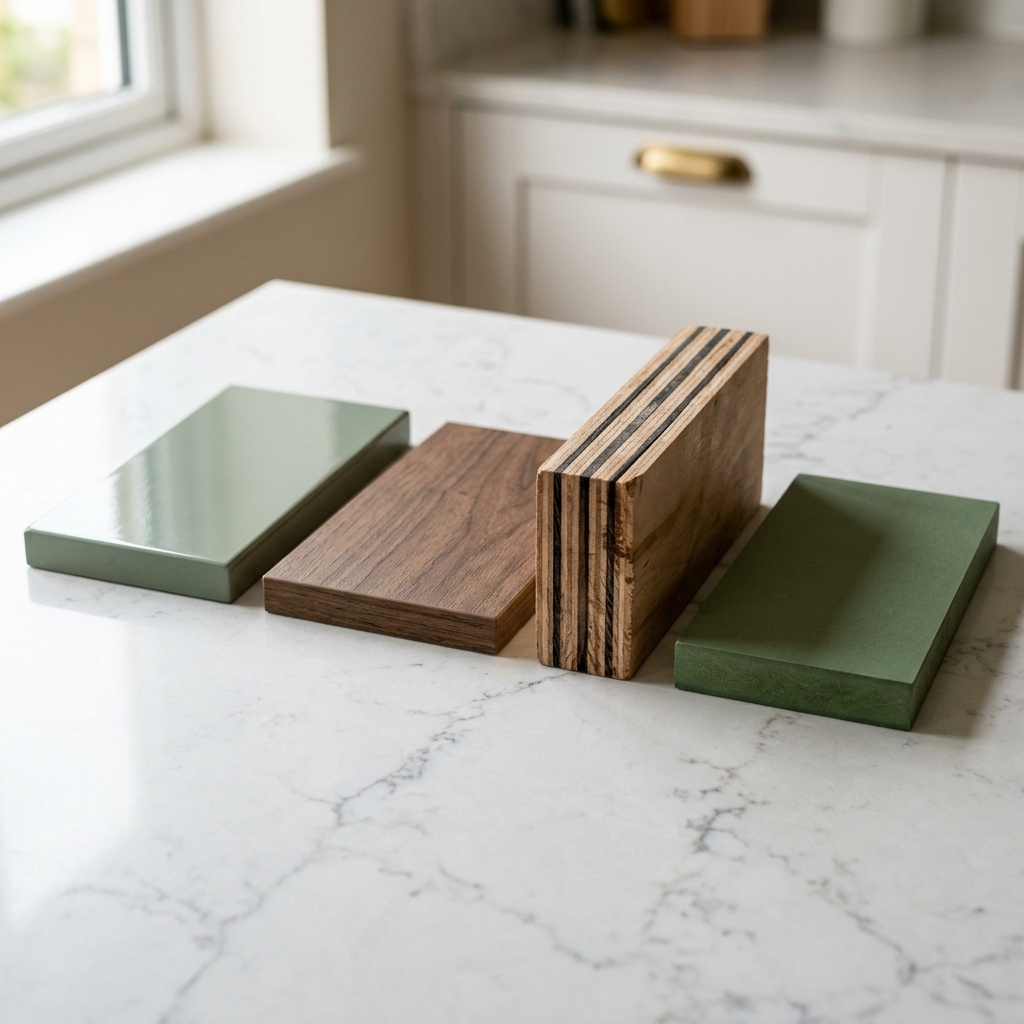
TL;DR
- BWP (Boiling Water Proof) plywood is the gold standard for kitchen carcasses — it resists moisture, holds screws firmly, and lasts 20+ years
- HDHMR (High Density High Moisture Resistant) board is the modern alternative — denser than MDF, moisture-resistant, and more consistent than plywood
- MDF is fine for dry areas (wardrobes, TV units) but not recommended for kitchen carcasses — it swells in moisture
- Particle board is the cheapest option and the worst — it fails in 5–8 years in Indian kitchen conditions
Quick Answer: For modular kitchen cabinets in Indian homes, specify 18mm BWP (Boiling Water Proof) plywood or 18mm HDHMR board for the carcass (the cabinet box). BWP plywood has a proven 20+ year track record. HDHMR is a strong modern alternative with more consistent density and better machinability. Never accept MDF or particle board for kitchen carcasses — both swell and fail with the moisture and heat that Indian kitchens produce.
When you book a modular kitchen, most people focus on the visible elements — shutter colour, handles, countertop. But the material inside the cabinet box (the carcass) determines how long your kitchen lasts. A kitchen with beautiful acrylic shutters on a particle board carcass will start failing within 5–7 years. This guide tells you exactly what to ask for and why.
Full Carcass Board Comparison
| Board Type | Moisture Resistance | Screw Holding | Strength | Lifespan (Kitchen) | Cost (per sq ft) | Verdict |
|---|---|---|---|---|---|---|
| BWP Plywood (IS:710) | Excellent — survives boiling water immersion | Excellent | Very High | 20–25 years | ₹70–₹150 | Best choice |
| BWMR Plywood (IS:303) | Good — moisture resistant, not boiling water | Good | High | 15–20 years | ₹50–₹100 | Good choice |
| HDHMR Board | Good — HMR certified, consistent density | Very Good | High | 15–20 years | ₹55–₹110 | Excellent modern alternative |
| HMR MDF | Moderate — moisture resistant but not waterproof | Moderate | Medium | 8–12 years | ₹40–₹80 | Acceptable for dry zones only |
| Standard MDF | Poor — swells in moisture | Poor | Low | 5–8 years | ₹30–₹60 | Never use in kitchen |
| Particle Board (PB) | Very Poor — disintegrates with moisture | Very Poor | Very Low | 3–6 years | ₹20–₹45 | Avoid completely |
BWP Plywood: Why It Is the Kitchen Standard
BWP stands for Boiling Water Proof — IS:710 certified plywood that can withstand immersion in boiling water for 72 hours without delaminating. This test confirms the adhesive between plies is fully waterproof (phenol formaldehyde resin), not just water-resistant.
In a kitchen context, BWP plywood handles steam from the hob, water splashes near the sink, and the sustained humidity of a room used for cooking daily. The layers of wood veneer give it natural strength and excellent screw-holding — hinges and drawer runners stay firmly mounted for years without loosening.
What to specify: 18mm BWP plywood (IS:710 certified) for all base cabinets, wall cabinets, and tall units. Some brands use 12mm for the back panel — this is acceptable. Ask the dealer to confirm the IS certification number and brand (Century, Greenply, Kitply, National are established Indian plywood brands).
HDHMR Board: The Modern Factory-Friendly Alternative
HDHMR (High Density High Moisture Resistant) is an engineered board made from compressed wood fibres — much denser and more moisture-resistant than standard MDF. It is increasingly used by quality modular kitchen manufacturers because:
- More consistent density than plywood — no voids, knots, or grain variation, which means CNC-cut edges are cleaner and more precise
- Better machinability — routed profiles and edge-banded finishes look crisper than plywood
- No delamination risk — being a single homogeneous board rather than glued plies, there's no ply separation over time
- HMR certified — passes IS:12406 moisture resistance standard for use in humid environments
HDHMR is not equal to BWP plywood in raw strength, but for most modular kitchen applications (cabinet boxes up to 900mm wide) it performs comparably. If your kitchen has unusually heavy storage loads (full-height bottle units, heavy cookware collections), BWP plywood is the safer choice for base cabinet carcasses.
Why Particle Board Is the Biggest Risk in Indian Kitchens
Warning: Many budget modular kitchen packages use particle board carcasses at an attractive price point. Particle board is made from compressed sawdust and urea formaldehyde resin. In Indian kitchen conditions (daily cooking steam, occasional water splashes, seasonal humidity), the board expands, loses screw-holding ability, and starts physically crumbling within 3–6 years. A cabinet that cost ₹50,000 on particle board will need full replacement in 6 years — not a saving.
The tell: particle board is significantly heavier than plywood of the same size (higher density from compressed sawdust) and feels slightly hollow when knocked. A legitimate dealer will confirm the board type in your quotation — if it's not specified, ask explicitly and get it in writing.
What to Specify in Your Kitchen Order
| Cabinet Part | Recommended Material | Minimum Thickness |
|---|---|---|
| Base cabinet carcass (sides, top, bottom) | BWP Plywood IS:710 or HDHMR | 18mm |
| Wall cabinet carcass | BWP Plywood IS:710 or HDHMR | 18mm |
| Tall unit / pantry column carcass | BWP Plywood IS:710 (higher load) | 18mm |
| Cabinet back panel | BWP Plywood or HMR MDF | 12mm minimum |
| Shutter (door panel) | HMR MDF or HDHMR (shutter-specific) | 18mm |
| Drawer box sides | HMR MDF or solid wood (branded tandem systems use steel) | 12–15mm |
Frequently Asked Questions
Which board is best for modular kitchen carcass in India?
18mm BWP (Boiling Water Proof) plywood with IS:710 certification is the best material for modular kitchen carcasses. It resists moisture, holds screws firmly over years of daily use, and lasts 20–25 years in Indian kitchen conditions. HDHMR board is an excellent modern alternative with more consistent density and cleaner CNC edges — suitable for all kitchen carcass applications.
What is BWP plywood and why is it important for kitchens?
BWP stands for Boiling Water Proof — IS:710 certified plywood bonded with phenol formaldehyde resin that remains intact even after 72 hours in boiling water. In kitchen use, this means it handles steam, humidity, and occasional water contact without swelling or delaminating. It's the Indian standard for kitchen carcass material because Indian cooking involves sustained heat and steam that standard plywood or MDF cannot handle long-term.
Is HDHMR better than plywood for modular kitchen?
HDHMR and BWP plywood are comparable for most kitchen applications. HDHMR has more consistent density (no voids or grain variation), machines more cleanly for CNC cuts and edge banding, and doesn't delaminate (no glued plies). BWP plywood has slightly higher raw tensile strength and a longer track record in Indian kitchens. For standard kitchen loads, both materials perform similarly over 15–20 years. Either is a correct choice; both are vastly superior to MDF or particle board.
What is the difference between BWP and BWMR plywood?
BWP (Boiling Water Proof, IS:710) is bonded with phenol formaldehyde — fully waterproof. BWMR (Boiling Water and Moisture Resistant, IS:303) is bonded with urea formaldehyde — moisture resistant but not fully waterproof. For kitchens, specify IS:710 (BWP) — it's the appropriate standard for a room with daily heat, steam, and potential water exposure. BWMR is acceptable for bedroom furniture and wardrobes but is a step down for kitchen carcasses.
Is MDF good for modular kitchen?
Standard MDF is not recommended for kitchen carcasses — it swells significantly when exposed to moisture. HMR MDF (High Moisture Resistant) is better and is used for shutter panels (not carcasses) in quality kitchens. For carcasses (the cabinet box structure), always specify BWP plywood or HDHMR. MDF is suitable for dry applications — TV unit back panels, wardrobe interiors — but not for the structural box of a kitchen cabinet.
What should I look for on a modular kitchen quotation for materials?
Your quotation should explicitly state: (1) Carcass material — BWP IS:710 plywood or HDHMR board, (2) Carcass thickness — 18mm minimum, (3) Shutter material — HMR MDF / HDHMR + finish type (acrylic/laminate), (4) Countertop material and grade, (5) Hardware brand (Blum/Hettich or equivalent). If any of these are missing or vaguely described as "quality board" or "premium material," ask for specifics in writing before signing.
How can I identify if my kitchen has particle board carcasses?
Three tests: (1) Weight — particle board is heavier than plywood for the same size (higher density from compressed sawdust), (2) Edge examination — particle board edges show a uniform grey-brown compressed sawdust texture; plywood edges show distinct wood grain layers (plies), (3) Screw test — loose hinges or drawer runners in a relatively new kitchen often indicate particle board that has lost screw-holding. If in doubt, ask your dealer to show you a material sample before installation.
What thickness plywood should be used for modular kitchen?
18mm is the standard and correct thickness for all main carcass panels (sides, top, bottom of cabinet boxes). Back panels can be 12mm. Anything less than 18mm for the main carcass makes the cabinet structurally weaker and reduces screw-holding at the hinge and runner attachment points. Some very budget kitchens use 16mm — technically functional but not recommended for kitchens with heavy daily use.
Key Takeaways
- Specify 18mm BWP IS:710 plywood or 18mm HDHMR for all kitchen carcasses — these are the only two materials that last 15–20 years in Indian kitchen conditions
- Never accept MDF or particle board for carcasses — both fail with moisture and heat, typically within 5–8 years
- Get the board type and certification (IS:710 for BWP) in writing in your quotation — vague terms like "quality board" are a red flag
- HDHMR is not inferior to BWP plywood for standard kitchen loads — both are correct choices that your dealer may use based on their manufacturing process
- The carcass material is the most important invisible specification in a modular kitchen — it determines longevity more than any visible element
See These Ideas in Real Homes
Free · No Obligation
Talk to Our Design Experts
Ammon Marketing Editorial Team
Authorized Kutchina Dealer · Ranchi · Est. 2014
Our guides are written by Ranchi-based kitchen designers and appliance experts with 10+ years of on-the-ground experience. Every recommendation is based on real projects completed in Jharkhand homes — not generic advice from outside the region.