Sliding Door vs Hinged Door Wardrobe: Which Is Right for Your Room?
Ammon Marketing
Authorized Kutchina Dealer · Ranchi
02 Jul 2026
~ read
TL;DR
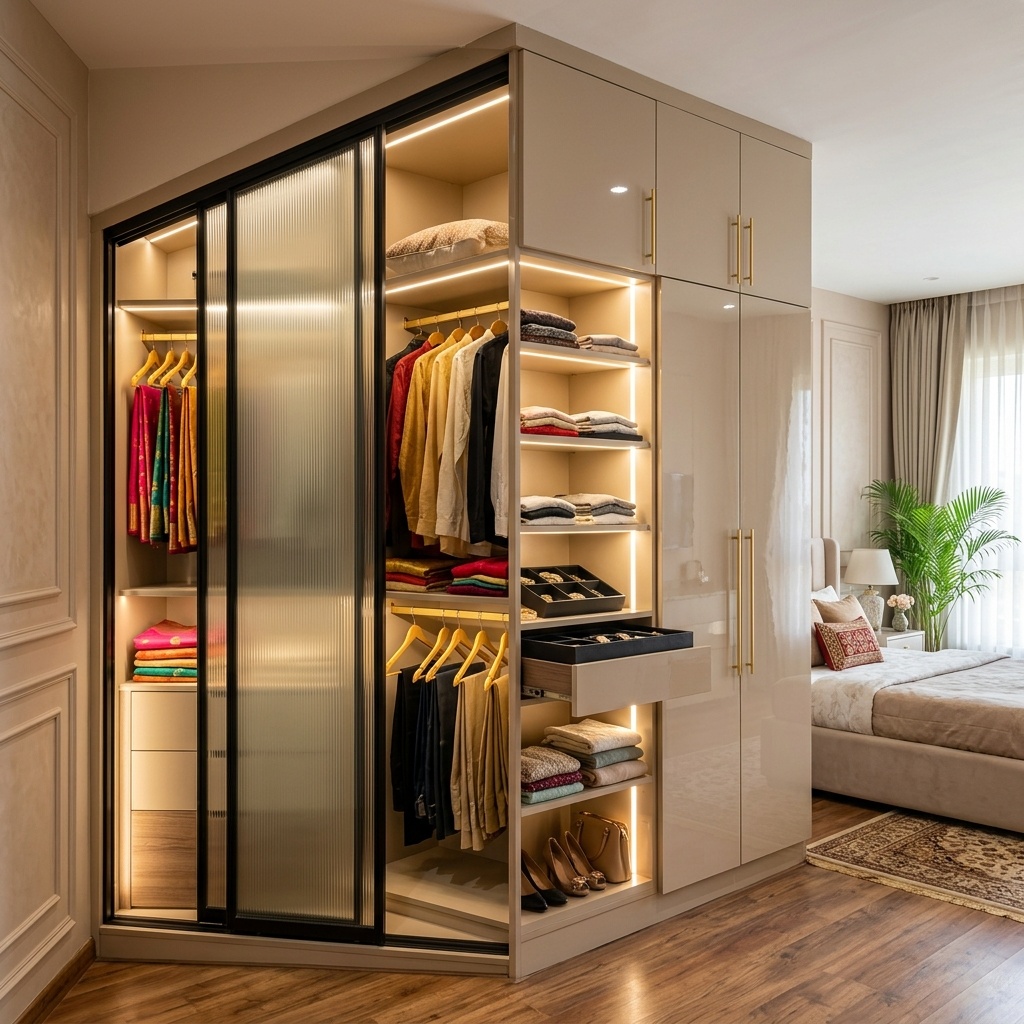
- Sliding doors suit smaller rooms (under 11 ft wide) — no swing clearance needed in front of the wardrobe
- Hinged doors give full-width access to the entire wardrobe at once — better if you need to see everything simultaneously
- Sliding doors cost 20–35% more than hinged for the same wardrobe size due to track and roller hardware
- Hinged doors need 2–2.5 ft of clear floor space in front of each door to swing open — in small rooms this can obstruct the bed or walkway
Quick Answer: If your bedroom is under 11 ft wide or the wardrobe faces the bed with limited floor space, choose sliding doors — they save the 2–2.5 ft swing clearance that hinged doors require. If your room is 12 ft+ wide and you want easy access to the full wardrobe at once, hinged doors are more practical and cost less. Room size and clearance available is the primary deciding factor.
Full Comparison
| Factor | Sliding Door Wardrobe | Hinged Door Wardrobe |
|---|---|---|
| Floor space needed | No swing clearance — wardrobe depth only | 2–2.5 ft clearance in front of each door |
| Access | Only half the wardrobe accessible at one time | Full wardrobe width accessible simultaneously |
| Cost (same size) | 20–35% more expensive (track hardware, rollers) | Lower cost — simpler hinge mechanism |
| Hardware maintenance | Track cleaning; roller replacement every 5–8 years | Hinge adjustment; simple, long-lasting |
| Interior utilisation | Slightly less — track at top/bottom takes 3–5 cm | Full interior height and depth usable |
| Design appearance | Sleek, modern, seamless panel look | Classic, more storage-visible, traditional or modern |
| Suitable room width | Any width — ideal for narrow rooms under 11 ft | 12 ft+ recommended for comfortable door swing |
| Installation complexity | Higher — track alignment required | Simpler — standard hinge fitting |
| Mirror integration | Excellent — full-panel mirror slides work well | Good — but mirror panel is a fixed swing weight |
| Portability (for renters) | Harder to move — track fixed to floor/ceiling | Easier to move — hinge pins removable |
Decision Guide by Room Situation
| Room Situation | Recommended Door Type | Why |
|---|---|---|
| Room width under 10 ft | Sliding | Hinged doors would obstruct walkway or bed |
| Wardrobe faces the bed with less than 3 ft gap | Sliding | No swing space — hinged door hits the bed frame |
| Room 12 ft+ wide with open floor in front of wardrobe | Hinged | Full access, lower cost, simpler maintenance |
| Wardrobe in corner or alcove | Sliding | Corner wardrobes with hinged doors are hard to access |
| Large wardrobe with many sarees or suits needing side-by-side view | Hinged | Full-width access lets you see everything at once |
| Senior residents or users with mobility considerations | Hinged | Sliding mechanism requires lighter touch; heavy sliders can be difficult |
| Renter who may move | Hinged | Simpler to dismantle and reinstall at new property |
Frequently Asked Questions
Which is better — sliding or hinged wardrobe?
Neither is universally better — it depends on your room. Sliding doors are better for smaller rooms (under 11 ft wide) where hinged doors would obstruct the walkway or bed. Hinged doors are better for larger rooms where you want full-width access to the wardrobe and prefer lower cost and simpler maintenance. The single most important factor is how much floor space you have in front of the wardrobe — if less than 2.5 ft, sliding is the only practical choice.
Do sliding wardrobe doors save space?
Yes — sliding wardrobe doors save the floor space that hinged doors need to swing open. A 4-door hinged wardrobe (each door ~18 inches wide) needs 2.5 ft of clear floor space in front of each pair of doors. Sliding doors need zero additional floor space beyond the wardrobe depth. In an Indian bedroom where the wardrobe and bed compete for the same floor area, this space saving is significant.
Are sliding wardrobes more expensive than hinged?
Yes — sliding wardrobes cost 20–35% more than equivalent hinged wardrobes because of the track and roller hardware system. For a 6-ft wide wardrobe, sliding adds approximately ₹8,000–₹20,000 to the cost compared to the same wardrobe with hinged doors. The premium pays for the aluminium track system and precision rollers — quality roller hardware (from brands like Ebco or Hafele) is important; cheap rollers derail and are hard to replace.
How wide should a sliding wardrobe be?
Sliding wardrobes work best at 5 ft (150cm) wide minimum — below this, the sliding panels become too narrow to be practical, and you lose too much interior access when only one panel can be open at a time. Most Indian modular sliding wardrobes are 6 ft (180cm) or 8 ft (240cm) wide. For a 3-panel sliding wardrobe, minimum 7 ft width is needed for comfortable access to all three sections.
Can I convert a hinged wardrobe to sliding doors?
Technically possible but rarely practical. Sliding doors require a track system at top and bottom that is integrated into the wardrobe frame — retrofitting this onto an existing hinged wardrobe means modifying the frame structure. It is usually cheaper and less disruptive to order a new wardrobe with sliding doors than to convert an existing one. Conversion also only works if the wardrobe is a modular type — RCC or heavy carpenter wardrobes cannot be converted.
What is the maintenance difference between sliding and hinged wardrobes?
Hinged wardrobes have simpler maintenance — hinges occasionally need tightening (one screw) and the mechanism essentially never fails with branded hardware. Sliding wardrobes need periodic track cleaning (dust and hair accumulate in the bottom track) and rollers may need adjustment or replacement every 5–8 years. Neither requires major maintenance with quality hardware. Cheap sliding rollers (under ₹150 each) are a false economy — derailing is frustrating and replacement requires disassembly.
Can I have mirrors on sliding wardrobe doors?
Yes — full-panel mirror sliding doors are one of the most popular wardrobe choices in India, especially for smaller bedrooms where mirrors visually expand the space. A full-length mirror on sliding panels serves double duty as a wardrobe door and a dressing mirror, saving the cost and space of a separate dressing mirror. Ensure the mirror panel is tempered safety glass (not regular glass) — a falling regular glass panel can shatter dangerously.
What is the best wardrobe door material in India?
For sliding doors: 4mm tinted glass or acrylic panels on aluminium frames look the most premium; laminate-on-board panels are the most cost-effective. For hinged doors: acrylic or PU finish on 18mm HDHMR board gives the most premium appearance; laminate is the best value. Both door types can use the same surface finish — the choice between sliding and hinged is about mechanism, not material.
Key Takeaways
- Room width and clearance in front of the wardrobe is the primary decision factor — not aesthetics
- Under 11 ft room width or less than 2.5 ft clearance in front: choose sliding doors
- 12 ft+ room with open floor space: hinged doors are more practical and 20–35% lower cost
- Sliding doors allow access to only half the wardrobe at a time — plan the internal layout accordingly
- Full-panel mirror sliding doors are excellent for small bedrooms — visually expand the space and double as a dressing mirror
See These Ideas in Real Homes
Free · No Obligation
Talk to Our Design Experts
Ammon Marketing Editorial Team
Authorized Kutchina Dealer · Ranchi · Est. 2014
Our guides are written by Ranchi-based kitchen designers and appliance experts with 10+ years of on-the-ground experience. Every recommendation is based on real projects completed in Jharkhand homes — not generic advice from outside the region.